.png) 1 month ago
49
1 month ago
49
When Willem Dafoe took over at the creative helm of the Venice theatre biennale last year, he shaped the programme around his own passions. Dafoe selected experimental theatre companies that had influenced him as a young actor and took to the stage for an arcane and rather mannered two-hander by Richard Foreman which involved the declaiming of non-sequitur notes from a series of index cards. It all seemed less avant garde, more nostalgic.
This year, the 54th edition, is thankfully very different. Dafoe’s programme is broad and outward looking, with genuine cultural range and an interesting fusion of theatrical traditions. The lineup stretches from Europe to Indonesia (Yusril Katil’s Under the Volcano, among other productions) and India (Sharmila Biswas’s Mischief Dance). There is a flamboyant hybridity to shows such as Satoshi Miyagi’s Mugen Noh Othello, which melds Noh with Shakespeare, and Christos Stergioglou and Alex Drakos Ktistakis’ Cries, which combines physical theatre with musical storytelling, and contemporary themes with ancient Greek drama.
The only mannered thing about this year’s programme is its title, Alter Native, which according to Dafoe alludes to “encounters between cultures – moments when what is familiar enters into dialogue with you and becomes a catalyst for transformation”. If that sounds highfalutin and abstruse on paper, it contains an authenticity of purpose in practice.
A recurring theme emerges across Dafoe’s programme: that of giving voice to the marginalised and centring lesser-heard stories. Emma Dante, a celebrated Sicilian playwright who has devised work featuring outcasts and social pariahs, receives this year’s Golden Lion for lifetime achievement, which becomes its own bold mission statement.
And the latest production by Davide Iodice embodies this preoccupation in the most monumental of ways. Iodice is an Italian playwright who has previously made shows in a psychiatric hospital, a women’s prison and a homeless shelter; his new work, Promemoria, is the highlight of this year’s lineup by quite a measure.
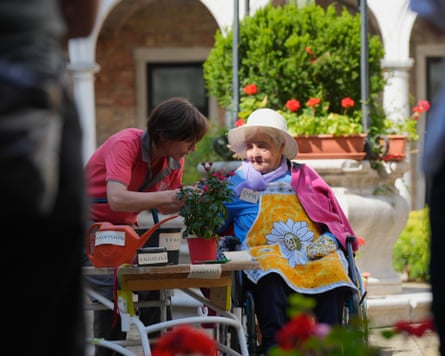
It takes audiences inside the San Giobbe, a care home for elderly people in Venice. We walk along its corridors and interact with 21 of its residents who either have cognitive decline or Alzheimer’s or are no longer fully self-sufficient. There are carers beside them as well as nine actors performing around them. We listen to their stories and watch them dance.
It is the result of a year-long workshopping process and a project of extreme tenderness – although it is not as unflinching as Alexander Zeldin’s play Care, set in a nursing home, which is currently at the Young Vic in London.
When asked about his preference for the upbeat and hopeful, Iodice says the pain is all there in unspoken ways: “What struck me most about these extraordinary actors was their incredible attachment to life, a strong desire to be part of it even in a condition of extreme vulnerability – a strength that gives strength. I sought to pay tribute to this kind, gentle force. Fragility, pain, illness, emergency are present in every corner of the hallway, in the smells, in the ceaseless sounds of running medical equipment, in the bells that call for assistance, in the constant movement of doctors and nurses, in the everyday life of this place. Yet even in this place, humanity manages to strenuously maintain its beauty, however residual. It is this beauty that always interests me.”
Cries by Stergioglou and Ktistakis distils the voices of migrants and those enslaved or displaced across time, from Hecuba after the sacking of Troy to the present day. It is presented mostly through song and staged by the six-piece band of performers at the open air venue Teatro Verde, which has the semblance of an amphitheatre and is situated on an island off the mainland. It comes alive in its angriest song about the experience of migrants who reluctantly flee their homes, in extremis, only to be met by hostility and prejudice in the west. “You have to understand: no one puts their children on a boat unless the water is safer than the land, no one wants refugee camps or strip searches,” one performer says in a song that becomes more of a hammering shout.
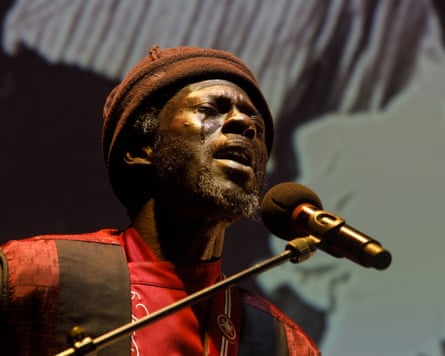
Miyagi gives voice to a marginalised Shakespearean character in Mugen Noh Othello, which reconfigures the drama to put Desdemona, the murdered wife of Othello, at its fore. A Japanese experimentalist who has respun several western canonical works before, he employs the ritual of Mugen-Noh theatre, which dates from the 13th century.
Miyagi explains that the protagonist of Mugen-Noh is always a ghost stuck in the loop of a repeated story. The aim of the dramatic ritual is to release this suffering character from their purgatory, partly through the act of storytelling itself: “Telling stories helps them resolve their anguish.” For Miyagi, this is what connects the Noh tradition with Shakespeare’s ghosts and their will to avenge in plays such as Hamlet.
There is a recognisable Noh chorus with drumming and percussion as Othello’s backstory is told, including his warring heroism. But the centre belongs to the ghost of Desdemona – an apparition perpetually outraged by her murder at the hands of her accusing husband for an infidelity she did not commit. As she barely has a voice in Shakespeare’s original text, this rearrangement shifts the axis of the play entirely. It is no longer about a fatally flawed war hero and the evocation of his violent jealousy through the devious manipulations of Iago but about a faithful wife and aggrieved spirit racked by righteous injustice and trapped in her terrible storytelling limbo. She, rather than he, is its tragic heart here.
Miyagi is not the only one who evokes the dead. Dorcy Rugamba’s Letter to the Absent is an adaptation of his book Hewa Rwanda, dedicated to his family who died in the Rwandan genocide of 1994. Theatre is a medium where the dead can be reborn, he suggests, and he says he wanted to bring back those who had died in a way that is not defined by their murderer. “The genocide kills people twice: first it kills in the body, but after that their existence itself can disappear in the way you tell their story. If you look at movies and books [about the genocide], the violence is so spectacular that it’s the story of the murderer. For me it’s necessary to find a way to give the victims their full story. So that they can become the main characters of the story and cease to be mere sufferers seen only through the lens of the horrific conditions of their deaths.”
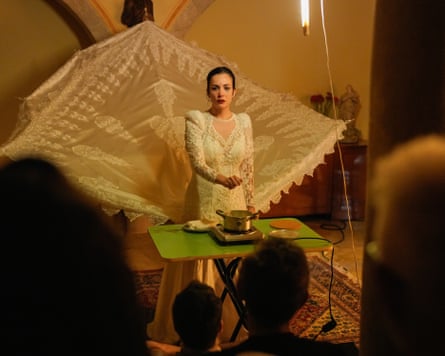
There are immersive aspects to several works. In Iodice’s piece, there is a maximum of 30 audience members per performance who travel through the rooms and gardens of the home. They are active participants invited into an art workshop to hear what residents have been creating or sitting among a group of elderly women who offer tea and reminisce about their former working lives and families.
Comparatively smaller scale is Mario Banushi’s Ragada, the first part of a wordless trilogy that deals in family bereavement, memory and burial rites. Banushi, a Greek playwright of Albanian heritage, is seen by many to represent the new face of Greek theatre and is the winner of this year’s Silver Lion at the biennale. The trilogy, entitled Romance Familiare (comprising Goodbye, Lindita and Taverna Miresia alongside this first instalment), is shown concurrently for the first time at the festival. Ragada takes place in what looks like a family living room, with audience members sitting in a space that hugs the room, some on the floor around the actors and enveloped by the intensely emotional drama taking place in such an intimate space.
Beyond the official lineup is a six-hour durational production of Samuel Beckett’s How It Is. Audiences have the option of watching it either in a continuous form or with breaks in between over the course of a day. It is a word-for-word staging of Beckett’s three-part novel, originally published in French in 1961. Regarded as something of an enigma, it is written in verses with no punctuation and features a lone figure amid a landscape of mud who hears multiple voices within and without.
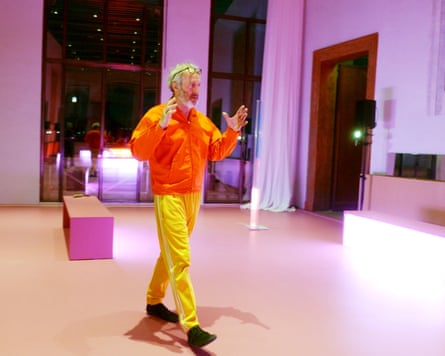
Although it is not part of Dafoe’s biennale, it chimes with the experiential and immersive nature of his programme nonetheless. A collaboration between Gare St Lazare Ireland and Berggruen Arts & Culture, the “live art event” takes place along the top floor of Palazzo Diedo. It is directed by Judy Hegarty Lovett, with design collaboration by the artist Michael Craig Martin, and stars Stephen Dillane along with Conor Lovett. “It’s a very oral text – it lends itself to the stage,” says Hegarty Lovett. It has been 10 years in the making by Gare St Lazare, which will be working on Waiting for Godot with Gary Oldman next year.
With this biennale, Dafoe concludes the minimum two years of tenure required of its artistic director. The question now is whether he will sign up for another two or more to come. It seems, in light of this year’s offerings, as if he is entering his stride. Watch this empty space?