.png) 1 month ago
52
1 month ago
52
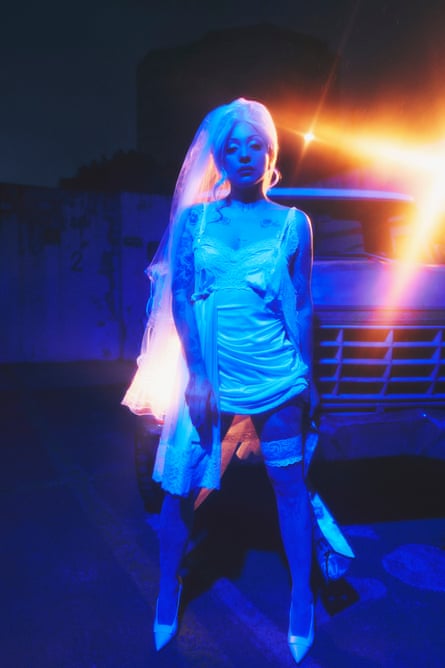
Mon Laferte has a sore throat. Halfway through our conversation, in a studio with no windows at the Sony offices above New York’s Madison Square Park, singer Norma Monserrat Bustamante Laferte meekly asks her manager for a latte without lactose, or coconut milk, if they have it. It’s the first truly hot day of spring. She’s in between arena dates across Latin America of her Femme Fatale tour. Tonight, she’ll skulk through Manhattan with rhinestone-studded eyelids and a Marilyn Monroe wig to film the Femme Fatale music video. Today, her hair is dyed red, cropped in spiky Marcel waves. She’s wearing a black slip dress and a pair of artful, lace-up tabis.
With a career spanning over two decades, Laferte holds more Latin Grammys than any other Chilean singer and is the country’s biggest female streaming star, with over 18m monthly listeners. In October of 2025, Laferte released her tenth record, Femme Fatale, a jazz album that saw her step into a vampy alter ego; this month sees the continuation of the story with companion album Femme Fatale Vol 2. Like the archetype, her vision of pop stardom is biting by design. “The archetype is the dangerous one, no? Dangerous for being free, secure,” she tells me in Spanish. “Femme Fatale is a name the press have given me.”
Embracing taboos is Laferte’s most punk trait. In 2019, amid a season of populist uprising and police brutality in Chile, Laferte appeared on the Latin Grammys red carpet in a green bandana, a symbol of abortion rights and reproductive freedom in Latin America, with a message written on her bare chest: “En Chile torturan violan y matan” (“In Chile they torture, rape and kill”). Her action drew heavy criticism from local press; she has described it as throwing herself to the lions. “Looking back today, I think that was quite important’,” she says. “Not just for the political moment in Chile, but in general, because it’s an image that keeps circulating and that a lot of young women suddenly see.”
Laferte was raised in the coastal city of Viña del Mar, Chile. She sang around town as a teenager to help support her working class family and, in 2003, became a national celebrity after performing on Chile’s Rojo Fama Contrafama, a singing competition TV show. In 2007, after moving to Mexico City, she sang on street corners and metro stations and commuted hours every week to a gig in Veracruz. Leaning into twee sounds saw her break out in 2015 with album Mon Laferte, Vol 1, which went four times platinum in her home country. There are still YouTube videos from around that time that show Laferte’s bravery in performance, singing with her guitar and her baby bangs singing about her worst heartbreak in a park or university hallway.
Femme Fatale Vol 2 deviates from the jazz of Vol 1, allowing her to revisit her old indie-folk sound with affection. On new song Eterno Resplandor De Una Mente Sin Recuerdos with Chilean singer Javiera Electra, the two women punctuate a tender guitar line with lyrics about a street corner in Mexico City’s Roma Norte or a Luis Alberto Spinetta song. It sounds like it could have been written on the kind of afternoon in your 20s when you ruin your own day, sung years later in a more forgiving register.
Both albums started in the same place: Mon’s notes app. She combed through decades of old unrecorded songs, compiling over 50 to revisit. She says she was most drawn to “the ones with the most honesty, a very raw way of saying the things I feel to the point that it’s almost uncomfortable to say them, you know?”

Naming the forces of capitalism, neoliberalism, and the listener as her benefactors and enemies, Femme Fatale Vol 2 opens with Laferte turning over the inherent contradictions of her performance, her career, and her music itself. “I don’t like to admit / that I became a commodity,” she sings in Spanish over meandering bass, before seeing the funny side: “Don’t ask me for coherence!” There is no resolution, just gleeful, growling scatting.
She describes Femme Fatale Vol 1 and 2 as a complete body of work that “is wholly feminist, without planning to make a feminist album.” On Por La Gracia De Dios, she honors women condemned for defending their lives on la bestia, the perilous ecosystem of freight trains throughout Central America that hundreds of thousands of people endure each year on the journey to the United States. On the free jazz, semi-improvised song 1:30, she layers her own memory of assault with the act of remembering itself. “It’s [one] of the things that costs me the most to say,” she says. “Because it’s my life and my stories, from when I was very young. And it ends up very political.”
“I believe in feminism, even though it gets stained, and its name has been degraded,” she says. “You say, ‘I’m a feminist,’ and it’s like: ‘You’re evil,’ or ‘You’re dangerous’.” She laughs a little at the melodrama. “I think it’s important to keep talking about feminism. Feminism benefits us all, no?” she says. “It’s not a bad thing.”
Several years back, she was diagnosed with bipolar disorder, which she says has allowed her to sustain emotional vulnerability in her writing. On new song Hello Monserrat, she tells herself they need to talk about botox, medication and taxes alongside her relationship with her mother. “Sometimes I slip into this state of hypersensitivity where I find a lot of inspiration,” she says. “I feel it all when I’m there. And later, when I’m calmer, I look back and despite the discomfort of it all, something beautiful emerges.”
Laferte’s life now looks a lot different from her protagonist’s. “In life, I’m … zero femme fatale,” she laughs. She lives in Tepoztlán, a town an hour-and-a-half outside of Mexico City. She spends her days in a bun and a washed face. She likes plants, she likes to cook, she likes to paint and play with her son. “I’m a señora that loves to go to, I don’t know, Ikea.”
“Norma day to day, I’m a disaster,” she insists. “I’m very lucky because I have such a normal life. I go out in my town, no one recognizes me, no one talks to me, I can go to the grocery store. I swear to you, I even take the metro in Mexico City. No one recognizes me. Because without my Mon costume, I’m free.”
Later, I remember a recent TikTok she posted apologizing to a fan that recognized her at a quinceañera store while she was buying a tiara for her costumes. She felt guilty; she told the fan she wasn’t Mon Laferte. And she wasn’t, not exactly. “I have this double life between Superman and Clark Kent,” she laughs. “It’s awesome.”
-
Femme Fatale Vol 2 is out on 12 June