.png) 4 hours ago
4
4 hours ago
4
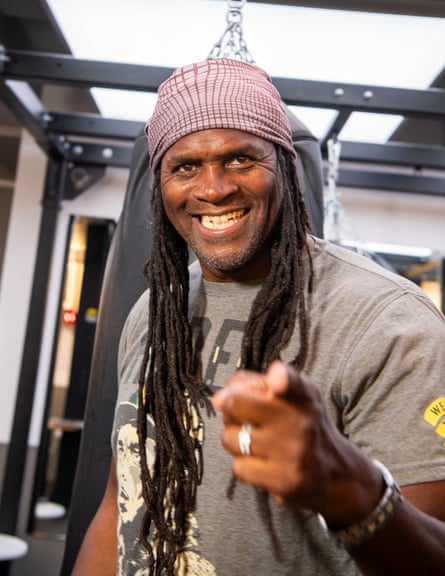
“I was the Olympic champion, and I was the next big thing, but the system had to win,” Audley Harrison says as he reflects on his rise and fall as a fighter who changed so much in British boxing while failing to fulfil his grandest ambitions in the ring. Harrison had once been considered a likely successor to Lennox Lewis, the undisputed world heavyweight champion, but he became a figure of ridicule mocked as “Fraudley Harrison”.
He retired in 2013 with a modest 31‑7 record and having never come close to winning the world title many thought would be his inevitable glory when he took gold at the Sydney Olympics in 2000. But Harrison dragged British boxing fleetingly into the mainstream and ripped up the old traditions of the fight game by managing and promoting himself.
Now, aged 54 and briefly back in London from his permanent home in Los Angeles, Harrison is as garrulous as ever while bringing a calm acceptance to his reflections on one of the strangest stories in British boxing history. He also sounds free of bitterness.
“The system cannot let an individual turn over the applecart. I understand that now so there are no hard feelings,” he says. “I was a rogue agent and they did what they had to do to protect their system.”
For Harrison, “they” consists of the BBC and the boxing business run by promoters and managers. In his version of events, the BBC fell hard for him after the Sydney Olympics and paid him well over £1m to restore boxing to terrestrial television before they became disenchanted when his career stuttered and he would not cede control to their preferred promoters.
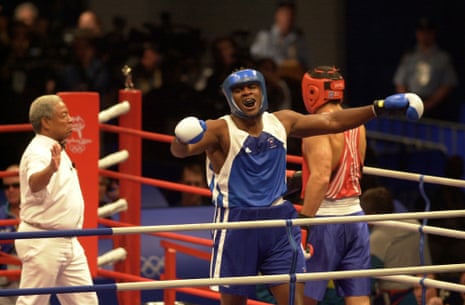
According to Harrison: “when me and Kellie Maloney [the former manager and promoter] were in the Celebrity Big Brother House [in 2014] she told me: ‘We were out to get you. You couldn’t make it because you’re just the boxer.’ It was a coordinated campaign.”
Maloney confirmed the veracity of Harrison’s account. “Audley wanted to change the face of boxing. So we had a coffee and a chat with his first opponent [Mike Middleton in May 2001]. He was an American and we went to his hotel in Wembley and persuaded him that if he allowed our lawyer to represent him we would get him more money.
“We made sure that he ended up getting double what Audley and the BBC had agreed to pay him. It was a good lesson for Audley.”
It is also important to acknowledge how much positive change Harrison brought to boxing. “A lot of people don’t know this, but, in 1998, I set up the Amateur Boxing Union and launched this campaign,” he says. “We did this petition and marched to parliament. I’d done my own press releases and we were on television and in the newspapers.
“Tony Banks was the sports minister and when we got to his office he let me in. I had a stack of petition signatures and he said: ‘I’ve heard about your amazing work. What do you need?’ I said we need £500k to get a full squad to the Commonwealth Games. [Banks] gave it to us and we were able to train fully and we won four golds and that allowed us to have a team of 12 boxers try to qualify for the Olympics.”
Harrison was one of those gold medal winners, but he was driven by the Olympics. “British boxing didn’t have the money and that’s why we hadn’t won [an Olympic] gold medal since 1968, with Chris Finnegan. I knew the impact and the leverage I could have, and boxing could have, if I won that gold medal.”
Harrison achieved his dream and he says: “It changed my life and it changed [British] boxing because of the money that was put into the sport. That gold medal kickstarted the world-class programme you see today. From there we had Amir Khan in 2004, and in 2008 you had gold from James DeGale.
“That brought in more money and then 2012 and Anthony Joshua really kicked off. But if I didn’t win the first gold medal, there would have been none of that money.”
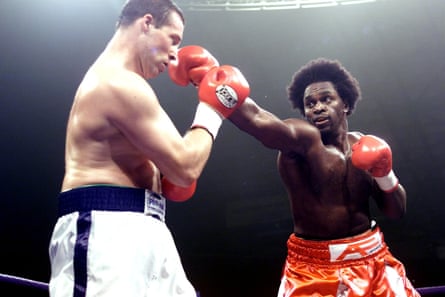
Harrison says: “I’d captured the public imagination and ended up creating something unprecedented. I wanted to be independent [by setting up A‑Force Promotions]. Greg Dyke made that become a reality because he was the BBC’s director general and a boxing fan.”
Injury and inexperience blighted the first 10 fights of his BBC contract. He won them all without producing any fireworks. “It was a learning curve, but I got crucified,” Harrison says. “Greg Dyke said: ‘Listen, we just care about the viewing figures.’ But the product wasn’t there because I’m an amateur turning professional and I’m headlining. They said: ‘You can’t have someone else headlining because all the grandmas know you.’”
Harrison points out that “I was getting 2.2 million watching my fights on average”, but after his 11th straight win, against Mathew Ellis [in May 2003], a brawl broke out at ringside. “That was the nail in the coffin. They were saying: ‘Audley, you have to be controlled.’
“The BBC wanted me to give up my company and just become a boxer and sign with Mick Hennessy or Dennis Hobson as my promoters.”
When he refused he “got exiled to America. The BBC said: ‘We’ll give you a three-fight deal but it cannot be on UK soil.’”
Harrison retained his independence and, with real ingenuity, went to the US and struck a separate three-fight deal with ESPN while retaining his links with the BBC. Peter Salmon, the corporation’s head of sport, then extended the deal by another three fights, to be held in the UK, with the proviso that Harrison scaled back his promotional duties.
“But in January 2004, Greg Dyke left the BBC,” he says. “Now, for the anti‑boxing brigade within the BBC, Public Enemy No 1 was Mr Audley Harrison.
“They chose Julius Francis for the second fight and I said: ‘Listen, I go out partying with Julius and boxed him as an amateur. He’s not the right fight.’ It was a 12-round bore, horrible, until I knocked him down in the last round. Who got crucified? I did.”
Harrison boxed three times from March to June 2004. “Tomasz Bonin was the last one and I hadn’t slept properly for three months doing these fights back-to-back, doing these crazy negotiations with the BBC.
“On the Sunday there was a full-page article in the News of the World: ‘Audley goes to Sky in shock deal’. We’re like: ‘What the hell? We’re not even talking to Sky.’”
after newsletter promotion
It emerged later that Harrison and Salmon were among the public figures whose phones had been hacked by the Mirror group of newspapers.
“On the Tuesday I had a meeting with Salmon to sign a new deal. But when I arrived he said: ‘That’s it. This is your last fight for us and there will be no more professional boxing on the BBC after Saturday.’”
Harrison shared the crushing news at a press conference on the Thursday and then: “Boom. Next thing I think I’m having a heart attack outside the press conference. I’m taken to hospital and a doctor said: ‘You’re not having a heart attack, but when did you last sleep?’ I said: ‘I haven’t slept much for four days.’ He said: ‘You’re in no condition to box on Saturday.’ But I had to.
“The next day my brother drove me to the weigh in. I had a full-on breakdown in the car. I thought I was dying. I was screaming, flailing my arms. I was deranged for a while, but when I got to the venue I calmed down. I put my hood on and did everything to hold it together.”
Harrison stopped Bonin in round nine. “I got the job done, but they took away my glory again. I’d hurt him, but they stopped the fight prematurely.”
He had to wait three days before returning to the US and Harrison says he spent most of that time in a darkened room. “I felt like Superman had left the building and Clark Kent is never going to be a world champion. That guy I’d been – A-Force, Superman – left the building in the back of that car.”
Harrison won his next two fights, in the US and his record was 19-0 when he lost a split-decision to Danny Williams in December 2005. Dominick Guinn beat him in his next bout and the world title dream was gone.
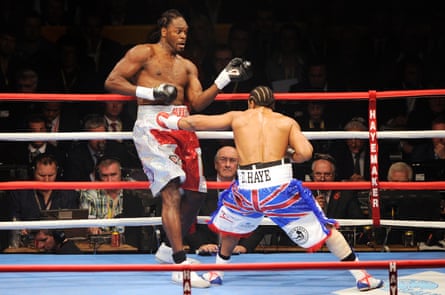
Harrison won 12 more fights, but he also lost another five. Defeat to David Haye in November 2010, when he was stopped in three rounds while barely throwing a punch, was embarrassing. But he talks philosophically in a corner of the BuddhaBox gym in Mayfair: “I had to learn these lessons because if I’d stayed on that pathway I’d be dead and gone now. I’m fortunate I got a second chance. My boxing career went to shit, but Clark Kent grew up.”
Harrison has lived in LA for years and he and his wife, Raychel, run a successful hair salon and beauty products business. “I’ve got a beautiful wife and house, two kids, and I’ve got substance, which I wouldn’t have if those things hadn’t happened.”
People are curious about him again. “I flew in for Wardley-Dubois [in Manchester in May] and it didn’t stop all night: ‘Audley, can we get your picture?’ It was like the Olympics again.”
He saw a brutal fight and Harrison says: “No disrespect to Wardley, but he came from white collar boxing and won an IBF title. That shows me how bad boxing is technically and tactically. But I was encouraged by Dubois. He’s developing those boxing fundamentals.”
What does he think of Moses Itauma, Britain’s new heavyweight sensation? “He looks good, but his last fight was against [Jermaine] Franklin, a gatekeeper. I need to see him go through the gears at a higher level.”
Did he watch Joshua’s recent fight against Kristian Prenga when the unheralded Albanian knocked him down twice in the first round? “Yes, Father Time is undefeated. The other day I watched a [2018] fight between Joshua and [Alexander] Povetkin. Povetkin’s a nasty puncher, but Joshua absorbed those shots and came back with a lovely finish. He’s lost that punch resistance, but he’s still AJ and coming for you.
“The Tyson Fury that boxed Deontay Wilder in those great fights, and the second one was so incredible it gave me an orgasm, is also not the same. Those hard fights take so much away from you. They’ll make Fury the favourite, but AJ will fight with real intensity against him. Fury has underestimated him and, unless he switches on, he’s going to be in trouble.”
Is Harrison really interested in that overhyped bout? “Big time. When Mike Tyson fought Lennox Lewis people were like: ‘It’s a horrible fight. It’s too late.’ But Lennox was in there cracking and Tyson was trying to land those big shots. Fury and AJ will be like that. It’s going to be something we’ll remember.”
Would Harrison like to return to boxing? “Yes. I’ve got my manager’s licence in America. The knowledge I have as a trainer, a manager and a matchmaker is unique and at the highest level. I’m not bragging, but the education I got is all in my head, waiting for somebody.”
Boxing is a dirty business and Harrison says: “It’s so unscrupulous and so dysfunctional and that’s why I’ve been happy to be out. But when I’m dead and gone, I can’t give this knowledge to nobody. I know I can develop an Olympic champion and a world champion so it would be a shame not to share it.”