.png) 1 hour ago
8
1 hour ago
8
When the Beatles waltzed unannounced into the 5th Street Gym in Miami Beach in 1964, the sports photographer Chris Smith seized the moment. He was there to record Cassius Clay (later Muhammad Ali) in training for his fight with Sonny Liston, but when the Fab Four began hamming it up with the Greatest, he captured the five most famous faces on the planet in one memorable shot.
Ali went on to furnish Smith with many unforgettable images over the years, and the photographer seemed always to be in the right place at the right time to document the host of larger-than-life sporting characters who peopled the last four decades of the 20th century, including George Best, Seve Ballesteros, Frank Bruno, Martina Navratilova and Lester Piggott.
Whether at niche events or the world’s greatest amphitheatres, Smith, who has died aged 88, sought to photograph human drama and emotion. He wanted to portray the moment when dreams are broken as well as when they are realised. As the sportswriter Hugh McIlvanney, with whom Smith worked extensively throughout his career, wrote in an essay in Smith’s 1987 book Sport in Focus: “He is a master of composition, but the flow of feeling through his pictures is almost invariably more important than the deployment of shapes, human or inanimate.”
When the boxer Barry McGuigan fought Steve Cruz for the world featherweight title in Las Vegas in 1986, it was 43C (around 110F) in the ring. The fighter from Clones, Northern Ireland, was struggling in the furnace and towards the end of the fight Smith caught a glimpse of McGuigan in his corner and knew what he had to do. At the end of the 13th round, Smith switched to a longer lens and captured what McGuigan would later call “the picture of me with the dead eyes”. The boxer ended up in hospital with heat exhaustion and dehydration.
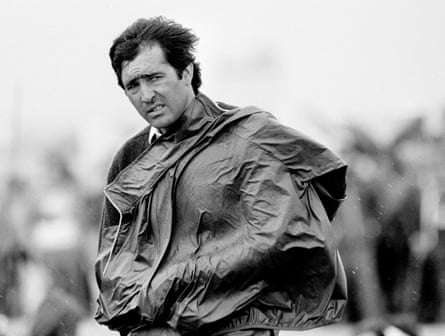
At the British Open in Sandwich in 1985, Ballesteros was a long way behind the leaders. When a squall momentarily whipped Seve’s waterproof across his body, Smith shot one frame that immortalised the Spaniard’s crushing disappointment and frustration. The image of the Golfing Matador won an award and Ballesteros said: “Good photograph. It says how I felt. It makes me remember.”
Smith would always turn up to events early, to try to outwit his photographic opposition. At the 100m at the Moscow Olympics in 1980, which featured the Scottish sprinter Allan Wells, Smith made the courageous decision to position himself alongside the start line. He focused on Wells and, when the starter fired his pistol, Smith fired his shutter. The explosion of Wells from the blocks screams animal instinct and determination.
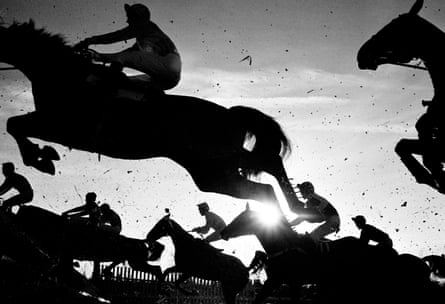
Though he was adept in the use of colour, it was black and white photography that showed the best of Smith. The play of light in his pictures would often accentuate the beauty and significance of landscape – where an ordinary steeplechase at Newbury takes on the extraordinary or pictures of golfers become studies in loneliness.
Smith was one of the most admired and decorated sports photographers that Britain has produced – he won Sports Photographer of the Year four times and individual Sports Picture of the Year twice. He also won a special award in the SSF World Sports Photo Contest in 1995. In 2012, Smith’s Ali photographs were exhibited at Alon Zaikam Fine Art gallery in London and there was a major retrospective of his work, Gods of Sport, at the National Heritage Centre for Horseracing and Sporting Art in Newmarket, Suffolk, in 2017. A collection of his Ali pictures, The Greatest, was published in 2024. In addition to his talent, it was his gentle, humble nature and his willingness to help his colleagues that made him an inspiration to a generation of sports photographers.
Smith was born in Hartlepool, County Durham, to Jennie (nee Vale) and Thomas Smith, a dock worker. After leaving school at 16, Smith joined the local evening newspaper, the Hartlepool Mail, as a trainee. He knew nothing about photography but mixed chemicals, printed, swept the floor and learned his craft. When it was quiet he would wander the streets of his home town with a plate camera, taking pictures of the docks, fishing fleet and steelworks. He remained at the Mail for three years and, during that time, as well as the obligatory local flower and dog shows, he began to cover sports events because, he recalled, “nobody else wanted to be out in all weathers on a Saturday”.
At 19, Smith served his two years of national service in the Grenadier Guards and, with a busby atop his 6ft frame, he cut an imposing figure on guard duty outside Buckingham Palace. When he left the army, he returned to Hartlepool but longed to work in what he described as “the mecca of journalism for newspaper people” – Fleet Street. A tour of London newspaper offices in 1959 resulted in an offer to join the Daily Herald (which became the Sun in 1964) as a junior. It was there, despite beginning to specialise in sports photography, that Smith picked up his first award – News Picture of the Year – for a shot taken at the dress rehearsal of Princess Margaret’s wedding in Westminster Abbey in 1960.
After eight years at the Herald, and a short stint freelancing, he was offered a contract at the Observer in 1968. At the Sunday newspaper – which had been home to one of his great inspirations, the sports photographer Gerry Cranham – Smith’s talent was trusted to provide pictures for the front page as well as the back. He was sent not only to Wembley and Lord’s but to New York and Prague to cover the funerals of Robert Kennedy in 1968 and Jan Palach in 1969. Smith’s work also appeared regularly in the Observer magazine.
In 1976 he became chief sports photographer for the Sunday Times, where he remained for 24 award-sprinkled years. While there, he shot what, when pressed, he said was his favourite photograph. He had never seen Italian football’s “ultras” before and when he witnessed their flares, smoke grenades and fireworks at the European Cup final between Roma and Liverpool in Rome in 1984 he jumped into the crowd to get a shot that is as much a dramatic news picture as a startling sports picture.
In 1964 he had married Sylvia Phillipson, who worked as a flight attendant for BOAC before having children. After Sylvia suffered a stroke 20 years ago, Chris put down his camera and devoted himself to caring for her at home.
He is survived by Sylvia, their sons, Dan and Josh, four grandchildren, and by his sisters, Barbara and Kathleen.