.png) 2 months ago
63
2 months ago
63
When Islamic State militants arrived at their family’s home in northern Iraq, Amera and her brother were sitting under their grandmother’s fig tree.
The 11-year-old girl had been watching a ripening fig for days but needed her older brother Ali’s height to reach it. Now, with IS beginning an assault on their town’s Yazidi people, she thought this may be her only chance.
The IS members arrived in five cars outside her home in Solagh, a village in Sinjar. They barked orders. Females and males were to be separated. A hand was on her shoulder pulling her towards the other Yazidi women and children.
Amera has not seen Ali since that afternoon of 4 August 2014.
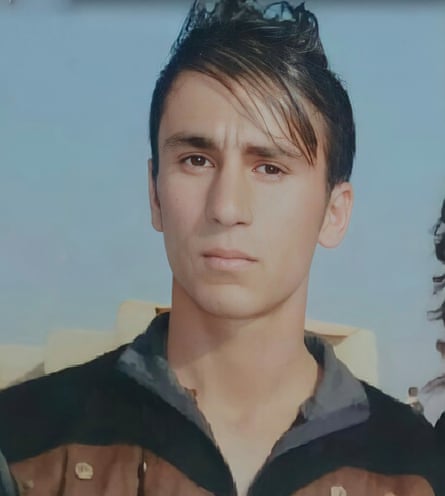
“He told me, ‘my heart always be with you,’” Amera, now 22, recalls.
Amera is one of more than 6,000 Yazidi women and children kidnapped and enslaved by IS. More than a decade after IS began their genocidal campaign against the Yazidis – killing and displacing thousands of the religious minority – she is fighting for the estimated more than 2,700 still missing.
This month, she published a book about her eight months in IS captivity.
The book, For Ali, For Us All: Messages From Captivity, under the pen name Amera Ali, comprises notes and letters written during her time in captivity. It’s illustrated by her cousin, Suad Smo, who was held captive for almost three years.
It chronicles her kidnapping – alongside her mother, three sisters and brother – and being ferried between locations as captives on buses with drawn curtains, to the sexual violence IS infected on women and girls, and finally their three-day escape.
Sign up: AU Breaking News email
The handwritten letters, translated from Kurmanji to English, began as secret messages to Ali, in the hope their discovery would lead him to her. She wrote on pens and paper found in a classroom desk at a school in Tal Afar, where she was imprisoned alongside 70 other Yazidi women and children for a month, and stashed the finished letters under desks, folded into her socks, and in her mother’s pockets.
“I wrote because I was scared, but also because I had hope. I believed that maybe, one day, someone would read my words and understand what ISIS did to us,” the book says.
While held in Badush central prison – where at least 1,000 Shia Muslims were massacred in what the UN later labelled a war crime – her mother warned about the danger of being caught writing. Don’t make any trouble or they will kill us, her mother said.
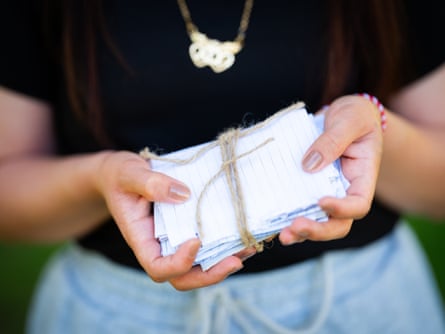
“I didn’t listen to my mum. I said: no, because they done a lot, lot of bad things to us. So I will, I will make something to make them angry,” she says.
“Sometimes when I [have] decided to do something … I can’t make myself stop doing that thing. I keep writing.”
When an IS fighter found her writing a letter in the prison, he burned it in front of her.
Later, Amera was separated from her mother and siblings for about four months when an IS member forced her to live in his house. The man, who was a friend of her uncle’s, had grown up and lived alongside the Yazidi community in Sinjar, sometimes sharing meals with her family, before he joined IS.
“He tried to do lots of bad things with me and then sell me to his uncle,” she says.
In April 2015, on her 12th birthday, Amera and the Yazdis she was held captive with reached Sinui – a Yazidi town in Sinjar – and were free from IS after escaping on foot.
For the next four years, her family lived in refugee camps in Iraq, often struggling to have enough food to eat. She describes those early months as “harder than Isis captivity”.
In 2019, they moved to Australia and settled in the regional New South Wales city of Armidale – a place that is now home to many Yazidi refugees.
Amera is attending university and studying law, but the trauma inflicted from the horrors of IS slavery has left a lasting impact.
Last month, political debate in Australia was dominated by the potential return of a cohort of 34 Australians – the wives, widows and children of IS fighters – held for years without charge in a detention camp in north-east Syria. It is a difficult subject for Amera and her family, and others who have suffered at the hands of IS militants.
Her focus is on getting more international attention, including from Australia, on an investigation to find the Yazidis who remain missing more than a decade after IS rampaged through their villages.
“We just need to know the truth about our loved ones,” she says. “Where is Ali, what happened to him?” Amera says.
Amera frequently re-reads the letters she wrote her lost brother.
“Each time when I’m trying to read them, I feel Ali is beside me and he’s listening to me,” she says.
Information and support for anyone affected by rape or sexual abuse is available from the following organisations. In Australia, support is available at 1800Respect (1800 737 732). In the UK, Rape Crisis offers support on 0808 500 2222. In the US, Rainn offers support on 800-656-4673. Other international helplines can be found at ibiblio.org/rcip/internl.html
In Australia, children, young adults, parents and teachers can contact the Kids Helpline on 1800 55 1800, or Bravehearts on 1800 272 831, and adult survivors can contact Blue Knot Foundation on 1300 657 380. In the UK, the NSPCC offers support to children on 0800 1111, and adults concerned about a child on 0808 800 5000. The National Association for People Abused in Childhood (Napac) offers support for adult survivors on 0808 801 0331. In the US, call or text the Childhelp abuse hotline on 800-422-4453. Other sources of help can be found at Child Helplines International