.png) 2 months ago
61
2 months ago
61
Some might say that Arthur Miller’s 1994 play is less often staged for good reason. Broken Glass is about the unhappy marriage of a Jewish American couple in Brooklyn and also about America’s inaction in the face of rising Nazi terror. You see the play straining to tie those two parts together – and yet this production becomes hypnotic and horrifyingly resonant.
It is 1938 and Sylvia Gellburg (Pearl Chanda) is a housewife whose legs suddenly, mysteriously, stop working after she reads about Kristallnacht in the newspapers. She is deemed a hysteric by her husband, Phillip (Eli Gelb) – a typical Miller man, outwardly able but nursing secret wounds and impotence – and a doctor (Alex Waldmann) labels her condition psychosomatic.
Miller seems to be playing Dr Freud (or Dr Charcot) in his psychological exploration of Sylvia’s paralysis, yet he is intent on giving it bigger political symbolism too. The domestic tyranny in Sylvia’s marriage is likened to a larger oppression.
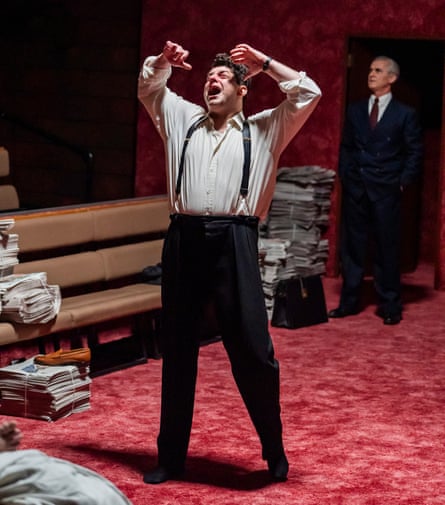
The interweaving of the personal, political, social and sexual seems inchoate, but there is so much emotive power in Jordan Fein’s production, such extraordinary performances by Gelb and Chanda, and so many chilling parallels to current political indifference to the horrors around the world, that the play’s lack of internal coherence becomes irrelevant.
Fein leans into the play’s messiness by employing a flamboyant kind of non-naturalism, from the glass screen behind which some characters glower at the drama on stage, to a central bed strewn with newspapers from 1938 and now. This part of the set, designed by Rosanna Vize to suggest a bedroom, waiting room and parliamentary chamber, is reminiscent of Cornelia Parker’s Left Right & Centre.
Sylvia’s paralysis is a metaphor for a world numb to the horror of fascism and her protest against it. Jewish Brooklynites around her ask each other what Nazi persecution has got to do with them – including the self-loathing Phillip, whom Gelb elevates, giving him much greater depth of pain. His looking away, for Sylvia (and Miller, it seems), is tantamount to complicity. Fein seems to be suggesting that these characters’ desensitisation to horrifying news reports is our own by mixing the headlines on Nazi terror with current ones such as “Gaza or gaga?”, about Donald Trump’s vision to rebuild the destroyed region into a tourist haven.
Tom Gibbons creates a brilliantly minimalist sound design with dramatic effects, although the show has a severe case of symbolism overload (such as the four clocks on the wall, airport style, suggesting the tyranny on the other side of the world is America’s own). There are shocking and riveting scenes, implicating the characters and the audience, even if the heavy-handed decision to leave the lights mostly undimmed is unnecessary.
Miller, in a 1994 interview, spoke of the terror rising up in his world again, including the war in Bosnia and Herzegovina, and said he couldn’t have believed that humankind would “devolve into this tribalism again”. If he could see us now.
-
At Young Vic, London, until 18 April