.png) 2 hours ago
3
2 hours ago
3
Bent double at the waist, Martin Curtis combs a stretch of a Dorset beach with the concentration of a man searching for a lost cufflink or wedding ring.
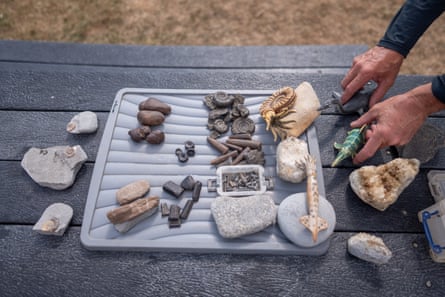
The search is meticulous – and with good reason. What he hopes to find could be far more valuable than an errant piece of jewellery. Curtis is searching instead for the telltale spiral of an ammonite, the star-shaped rod of a crinoid or rocks of a particular shape and colour that suggests there is something very special inside. He is hunting fossils.
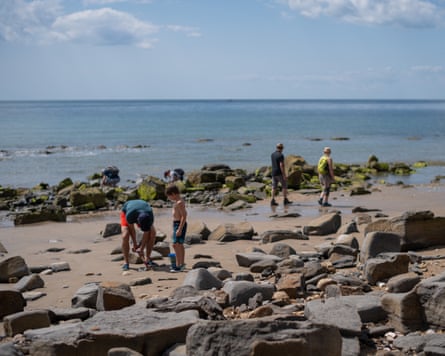
Along Charmouth beach and elsewhere on the Jurassic Coast, families with children, seasoned collectors and lone day-trippers peer intently at the ground in search of traces of creatures that lived 190m years ago. While some are here for fun, a growing number are here for business.
That growing professional interest reflects the rising popularity and value of Jurassic fossils, creating a thriving marketplace that has made some collectors social media celebrities and others very wealthy.
A Guardian investigation this week revealed that one of Britain’s most significant collections of Jurassic fossils was recently sold to a museum in Abu Dhabi for what is believed to be an eight-figure sum.
The collection, amassed by the private fossil collector Chris Moore, included 318 specimens, some of which may represent species previously unknown to science. The sale was described by some experts as a loss for the nation.
Yet while British museums lacked the funds to acquire Moore’s collection, wealthy institutions in the Gulf did not. For the fossil hunters combing Charmouth beach, it is another reason to scrutinise every promising item of unusual shape, colour and texture.
Fossil hunting – and the industry that has grown around it – is not a modern pursuit. Perhaps England’s best-known fossil hunter and dealer, Mary Anning, was born at nearby Lyme Regis in 1799 and made breathtaking discoveries along this coastline, including the first complete plesiosaur skeleton – a huge long-necked marine reptile that lived during the Jurassic period before becoming extinct alongside most dinosaurs 66m years ago.
Anning has not been forgotten. Her name and image are everywhere, from information boards along the seafront to the colourful Charmouth Heritage Coast Centre overlooking the beach. Here, fossil collecting is largely encouraged.
“On the rapidly eroding West Dorset coast, fossil collecting is essential if specimens, some of which may be of great scientific value, are to be saved from damage or destruction by the sea,” notes the West Dorset fossil collecting code of conduct.
And just as Anning sold many of her discoveries, fossils are still bought and sold today. Downstairs is a shop where small ammonites can be picked up for a few pounds, while larger specimens, painstakingly prepared within their surrounding rock, sell for several hundred. Provided hunters follow the code of conduct, ownership of fossils passes to the finder.
“Professional collectors have the most time, are able to react quickly to events that uncover the fossils – ie: storms and landslides – and have a great deal of local knowledge. But they need to sell their finds in order to earn a living,” the code notes.
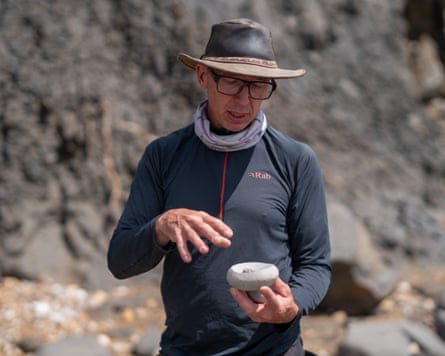
It is easy to understand how fossil hunting becomes addictive. As we comb the beach, Curtis points to a smooth, brown, bullet-shaped object: the fossilised remains of a squid-like creature known as a belemnite.
“That belemnite’s 190m years old. And we are the only three people to ever see that creature,” he says.
A little later, I spot a sparkling curve nestled among the pebbles and prise out a tiny ammonite, glittering with iron pyrite. It is the size of a penny and, though it is probably worth very little, I feel as if I have won the lottery.
As a professional guide and fossil hunter, Curtis knows these beaches intimately. “I spent a lot of my childhood on the beach with my father, finding fossils a bit further down the coast that way in Kimmeridge,” he says.
As an adult, he returned to the coastline while caring for his eldest daughter. “I could take her out on the beach, walk along for two hours looking for fossils [while she was] fast asleep in the backpack,” he says.
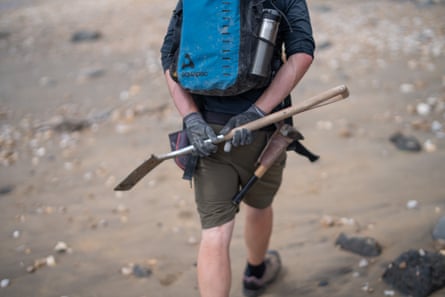
He later turned his hobby into a business, using his mountain leader qualifications to run guided fossil walks and selling specimens he has painstakingly revealed from the surrounding rock using air chisels and iron-powder air abrasion.
“I’m a big ammonite fan. They are my favourite fossils, and I’ve got loads of rocks at home with some really nice big special ammonites in, waiting to be prepared,” he says.
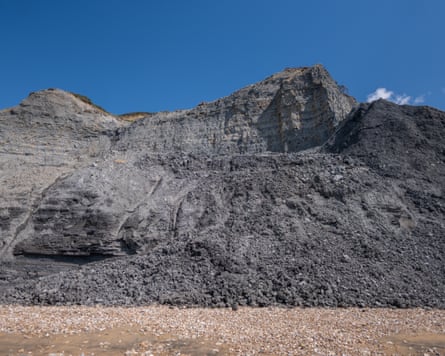
Progressing along the beach, we pass the remnants of huge mudslides, where it is clear there are many for whom fossil collecting is a more than a casual pastime. Hammers are swung, chunks of sticky mud broken apart and carefully examined. This is fossil hunting in earnest.
Curtis says TikTok and Instagram have transformed the activity in recent years. Social media is awash with videos of fossil hunters cracking open rocks on Britain’s beaches.
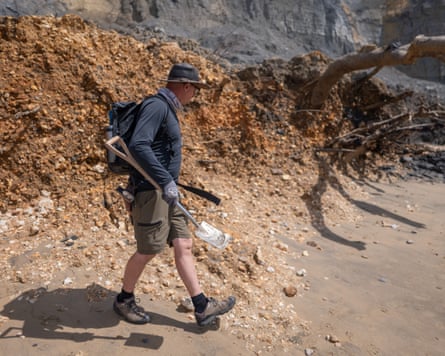
“It’s really changed the scope of fossil hunting down here. It’s now making it a lot harder because it’s introducing a lot more people to fossil hunting. I’ve been running walks here for 10 years now and the change [during that time] is quite significant,” he says, adding that the influx of fossil hunters during Covid staycations accelerated the trend.
Curtis believes parts of the coastline are being over-collected. “The erosion rate is struggling to keep up with the amount of people on the beach, because of the conditions,” he says, noting that fresh material is not being exposed quickly enough. And when new material does appear, word spreads quickly on social media. “So even on a[good day], there’s going to be twice as many people here.”
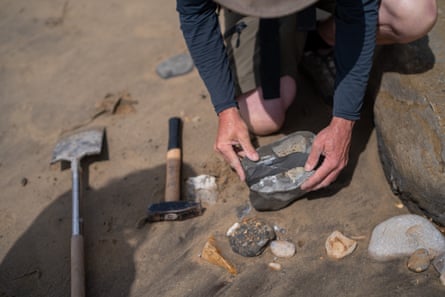
Competition among professional fossil hunters is intense, with experts keeping an eye on one another as they inspect new falls and vie for the finest discoveries. It is perhaps not surprising that rare finds or beautifully prepared specimens can command substantial sums.
“As fossil hunters, [when] we come to the beach, we are collecting to try to earn money. Maybe selling a few bits … online. But generally, we are collecting for ourselves. And if we find anything good, we keep it,” Curtis says.
Some fossil hunters have amassed remarkable collections. Figures such as Moore have become big names in the fossil-hunting world, with his specimens displayed in museums locally and beyond, and counting David Attenborough among his friends.
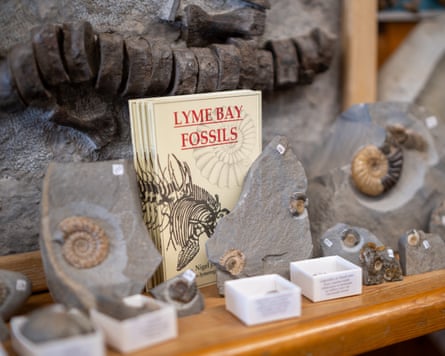
The recent sale has cemented Moore’s status as one of the Jurassic Coast’s leading collectors. But his collection is unlikely to be the last to leave Britain. As the country’s professional fossil hunters grow older, more private collections are likely to be in need of new homes.
Perhaps unsurprisingly for a man used to handling relics from millennia gone-by, Curtis is philosophical about his friend’s collection being sold overseas. “It’s always sad when things like that go abroad” said Curtis, adding that Moore had worked hard on his collection. “The key thing is it’s being enjoyed by someone,” he said. “It’s all well and good having a good collection, but it’s no good stuck in a box somewhere.”
There is a striking irony here. The remains of creatures that have been hidden in these shores for 190m years are now being sold to countries whose modern wealth is derived from plumbing their own oily depths.
Yet down on the beach in Dorset, the international marketplace feels a long way away. For Curtis, size isn’t everything – it’s all about the next swirl in the sand. “[A discovery] doesn’t have to be big. It just generally needs to be special. And the more you get into fossil hunting, the fussier you become,” he says.







![[seagull] review – silence proves golden in innovative if puzzling shot at Chekhov](https://i.guim.co.uk/img/media/a24223b73f2f7fcf7ea7b4f5b4f001f968cd3eb9/153_281_3293_2634/master/3293.jpg?width=1200&height=630&quality=85&auto=format&fit=crop&precrop=40:21,offset-x50,offset-y0&overlay-align=bottom%2Cleft&overlay-width=100p&overlay-base64=L2ltZy9zdGF0aWMvb3ZlcmxheXMvdGctcmV2aWV3LTMucG5n&enable=upscale&s=a3d221f69bffd24b83d26e9be3f1c934)