.png) 2 months ago
63
2 months ago
63
Fran Kirby knows what she brings. She always has. The Brighton forward is not young for a footballer but, at 32, she’s not old either and, injury free, is reminding people she still has it. “I know I am not the same player that I was when I was 25, I’m not naive,” she says. “That’s not who I am anymore, but I know what I can bring and that is creativity, the passes that other people won’t try. I’ve always said it: I will always try a pass, even if it doesn’t come off. That’s how I play. I play with risk. Sometimes it doesn’t work, sometimes it does.”
That eye for a pass is frequently on display. A recent standout was Kirby’s assist for Kiko Seike in Brighton’s thrilling 3-2 win over Manchester City. The obvious move was to play a pass into Seike’s feet; instead Kirby squeezed the ball between two defenders, taking them out of the action, and into space for her Japanese teammate to collect and fire in. It was vintage Kirby and, after her Chelsea career was blighted by injuries and pericarditis (inflammation of the heart lining), it is wonderful to see a woman who earned 77 caps for England playing at such a level.
“I’ve always had belief in myself,” Kirby says, sitting in Brighton’s Lancing training ground before the Women’s FA Cup semi-final against Liverpool on Sunday. “Even when things weren’t going well, even when I wasn’t playing, I felt like I could always do a job.
“A lot of people wrote me off. I know I’ve had my injuries, I know I had my illness, I know I didn’t play much towards my end of my Chelsea career, so I can completely understand that, but I’ve always had belief in myself and belief from the coach and players, and having that makes you feel confident. Sometimes you just need to get a rhythm, you need to get a flow.”
Kirby is more thoughtful on the pitch too. Age and experience have helped. “I’ve become smarter: instead of running around like a headless chicken, I stand and assess how everything else is going and I’ll see where people are standing defensively,” she says. “I just try to use my brain a little bit more. Of course, I always do the work defensively that I’m asked to do, I always do the runs that I’m asked to do, but it’s more taking the time to think: ‘OK, what does this moment need?’ I think I can assess it better than I did when I was 25.”
There is also a greater understanding of her body and its needs. “Some people out there say they don’t want their club to sign players over 30, but we understand our bodies more than ever,” Kirby says. “We understand the game, we’ve been there, done that. Where I’m at now, I understand my body more than I ever did when I was 22, 23 or 25.
“Sometimes you have to do multiple things before training to warm everything up. It’s coming in for treatment, ice baths at home, going in the pool at home in the evening when everyone’s sitting on their sofa. It’s a lot of different things just to make sure that everything is on the same page.”
The forward’s programme is highly individualised and she is grateful for the buy-in from those around her at Brighton into keeping her playing. “It’s a credit to the coaching staff, medical staff, strength and conditioning staff for understanding me,” she says. “That’s been really nice for me as a player, I want to be able to play every game and if there’s a way that I can do that and everyone’s willing to go with that plan, then that’s really great.
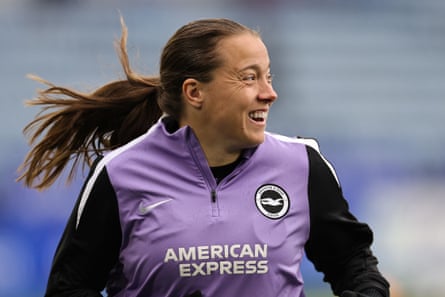
“There’s been a whole period of time, especially with my knee at Chelsea, that’s been in pain since I was 15 years old. If you were to ask me that before my surgery, I would say it was a pain every single day.”
Having had so many enforced breaks from playing, Kirby is focused on doing what she can to play for as long as possible. There is no headspace for anything but football. Even lounging on the sofa or walking the dog has her thinking about how those activities can contribute to recovery. “I don’t think my head ever switches off and I think that drives the people in my life quite crazy,” she says. “But it’s just because I know it’s been nearly taken away from me on numerous occasions and I know playing isn’t forever. So, while I’m in it, I have to give it everything, I have to invest in it, I have to do what I can. When I leave the training ground, I’m still a footballer. I’m a professional footballer 24-7. It doesn’t end.”
Kirby’s current physical condition contributes to how much she is enjoying football and life at Brighton, but there are other factors. Not least the culture at the club, which she credits for the team’s recent run of form, beginning with a 2-0 win against Arsenal in the FA Cup quarter-finals. That was followed by a 3-2 win over Manchester City, a 1-1 draw with Manchester United and Wednesday’s 1-1 draw with Arsenal in the Women’s Super League, a result that handed City the title.
“It’s really hard to keep a strong culture in a room full of so many people with so many different emotions,” Kirby says. “The culture that we have, the belief that we have, the work that people are doing for each other on the pitch is huge. You can be as good as you want at football but if you’re not willing to run through a brick wall for the person to your left and to your right, or make the right decision in the right moment that’s right for the team, then you’re not contributing to that culture. We’ve created something here with everyone involved and the desire to make this special.”
What was even more impressive about Brighton’s Women’s Super League draw with Arsenal on Wednesday was that they made seven changes with this semi-final in mind. “People underestimate how difficult it is not to be picked to play and how that feels as a player,” says Kirby. “The disappointment that they have week after week of not being selected can really build up and create a really negative feeling in you. For the girls who haven’t played much, who maybe haven’t got the minutes that they want to get, it was a really big moment for them to put out that performance. Everyone was so proud of the players who were on the pitch because it showed how hard they’ve been working.”
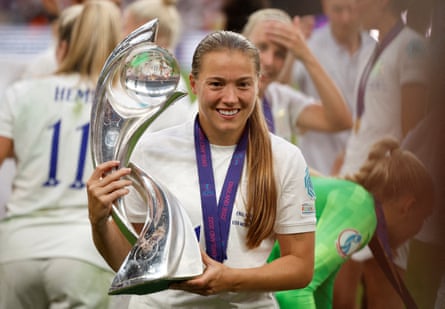
Credit also goes to the manager, Dario Vidosic. “He’s pure football,” says Kirby. “The way he wants to play, the style of play, I enjoy it, I feel it suits me as a player and it’s probably brought out a different side of my footballing ability as well.”
The chance to help Brighton reach an FA Cup final is a large carrot for a five-times winner of the competition, but doing it for Vidosic, who lost his father, Rado, also a coach at Brighton, in January would mean a huge amount to Kirby too. “He deserves it,” she says. “He’s had a really tough year. Obviously, it was a really tough point for the club as well. The way that he handled himself, the way he conducted himself, I don’t think many would have been able to do it.
“He is someone that loves this football club, even though he hasn’t been here that long. He’s a fantastic coach and the way he’s coached us this year, the way he’s improved this team, he deserves his chance to play at Wembley. Hopefully we can do it for him, hopefully we can do it for his dad and for his whole family too, to show that what he sacrificed, in terms of coming back so early after his dad passed away, was worth it. I hope we’re able to do that for him.”