.png) 1 month ago
42
1 month ago
42
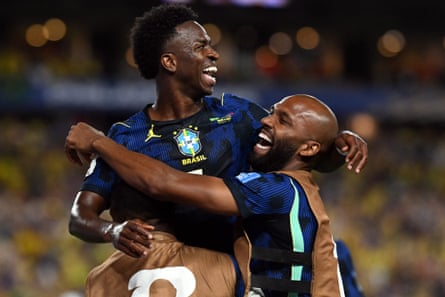
On a sticky, fun, occasionally boisterous, occasionally listless night in Philadelphia Brazil eased past a game but limited Haiti. All three goals in this 3-0 win came during a spell of first-half urgency driven by the high-grade wide play of Vinícius Júnior and Raphinha. In that period Brazil’s wide forwards were simply too much for a Haiti team that looked like it was trying to defend in a dogged low block, which gave the appearance of cautious, deep defence, but with the added key variation of also leaving huge open spaces in exactly the wrong places.
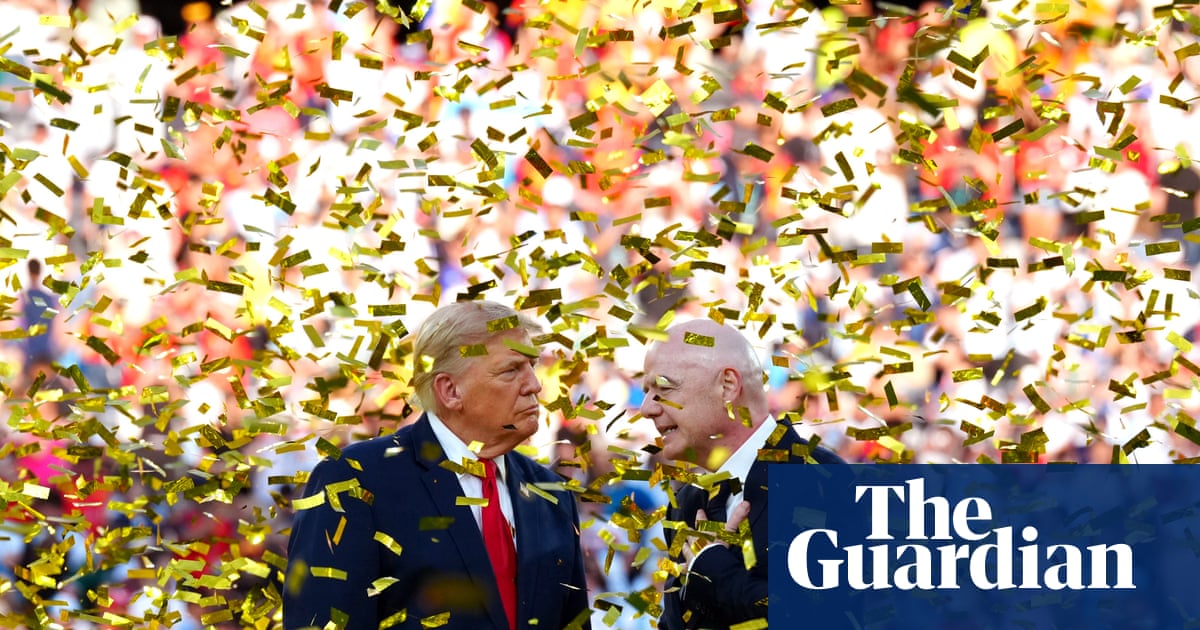
Haiti, with no goals and no points, are now certain to finish bottom of Group C and face a final fixture against Morocco in Atlanta next week. There is also an oddity for Scotland now, who are likely to play their fixture against Brazil uncertain as to what result is required, needing to wait for the other groups to finish before knowing their destiny. Thanks, again, for that Gianni. Pile ‘em high. Deal with the consequences later.
For Brazil this was a night of pieces jiggled into place, but with the odd broken part and dead end too, most notably the hamstring injury to Raphinha that is a genuine structural threat to their progress here. There were significant pluses too. Most notably Matheus Cunha was a slick and inventive presence in the centre after the more meat and potatoes turn from Igor Thiago in the first match.
This is a strange Brazil iteration. Nobody really knows what its ceiling is, or what, if anything to expect. What exactly is Neymar doing here? Apart from the obvious: waving, looking interested, wearing cool gear. How much is his presence worth commercially to the Brazilian FA, just in eyeballs and sponsor interest and celebrity heat? Probably quite a lot.
For now something about his presence here is already reminiscent of David Beckham’s non-speaking role behind Fabio Capello at the 2010 World Cup, stood there in his waistcoat and sculpted whiskers like a kindly, eager badger, an early glimpse of his omnimascot role at the current tournament as cash-raking sales frontman for beer, crisps and electric sanders.
But Brazil do have something. Bruno Guimarães, Lucas Paquetá and Casemiro is a really good, craft-laden midfield. Vinícius looks sharp and buzzy and hungry, a human expertly engineered for high-end wing play.
Are Brazil, of all things, dark horses here? Nerves, fear, the drag of history, Thiago Silva bursting into tears in press conferences. These are the things that have spooked and panicked Brazil teams in the past. They’re not really there this time, if only because nobody really expects them to win this World Cup. But nobody will want to play them either, not least in a place like Miami, where the heat will be like a full-body assault, and where the city will turn yellow for the day.
Brazil have elite talent. They have the most illustrious trophy-winning manager here, the great Carlo, who stood through most of the first half, always somehow slightly apart from all this, looking like a retired elite international hitman who now lives in a Tuscan castle and spends his evenings reading books printed on vellum and tinkling away on Mozart’s favourite harpsichord.
Afterwards Ancelotti was performatively calm and nonplussed, shrugging out his answers, a man who knows a large part of his job here is to keep everyone calm, like the captain on a jet rocked with turbulence mumbling over the intercom about flight times and perfume discounts.
He was non-committal on whether Cunha would remain as his central attacker. “He may.” That was it. “I don’t want a clear identity. Maybe we will change it in the next match.”
The atmosphere in the Philadelphia Stadium was sensationally good before kick-off. The city had been thronging all day with the blue and red shirts of the travelling Haitians, many from their US diaspora, mixing happily with the usual continental-scale contingent of Brazilians, many of whom had flocked to queue dutifully for a selfie with the Rocky statue, elevated for the last few days to the status of pilgrim’s shrine.
The stadium is a huge steeply-tiered angular thing, with shades of Darth Vader’s imperial fighter in its great black flying panelled wings at each end. Brazil started with seven Premier League players past and present, plus the former Everton manager flaneuring about on this touchline in an exquisite black summer suit and a pair of lace-ups fashioned out of unicorn leather by elite elven craftsmen.
Their early pressure was all down the flanks. Raphinha veered about in his private jet-stream, easing from right to left like a pond-skater. Haiti’s tactics were bizarre here. For some reason a collective decision seemed to have been made to leave a large expanse of empty grass on the flanks, in exactly – not even slightly or vaguely, but exactly – the spaces Vinícius and Raphinha would choose to run into.
Maybe it was some kind of bluff. How about if we do the one thing they’d never expect? What if we surprise them by appearing to play to their one great strength? On 21 minutes Brazil made the first of many chances from the same simple combination, Haiti advancing up the pitch because well, why not, leaving space for Raphinha’s run, but he dinked a lovely little falling-leaf finish wide. And they scored a minute later, Vinícius cutting inside and shooting straight at Frantzdy Pierrot. His block fell between Cunha and Hannes Delcroix, whose block flicked off Cunha’s leg and into the net.
The stands boomed and writhed with that familiar Brazilian triumphalism. The goal was Cunha’s second in 25 games for Brazil. His third arrived 10 minutes later. Vinícius made it with a twirl and a lovely pass between two defenders to find Cunha’s diagonal run. Pushed a little wide, he didn’t stop, kept going and smashed the ball high into the near post as Pierrot shifted his weight slightly the other way.
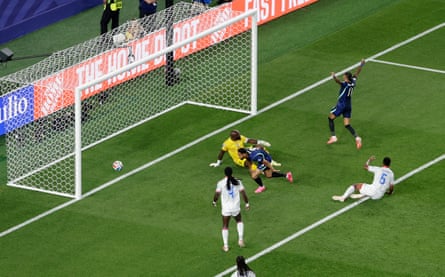
Shortly afterwards Raphinha limped off and was replaced by Rayan of Bournemouth, a precociously talented 19-year-old, but a 19-year-old nonetheless, making his third appearance here. For a while Vinícius was pretty much unstoppable one on one, just too swift in his lateral movements, to the extent it seemed inevitable he was going to get in on that side at some point. It came just before half-time. Paquetá floated a pass over the top. Vinícius surged in on goal, waggled his hips, and slid the ball into the net without breaking stride.
Half-time was a mass stomp-along to Bon Jovi, phone lights on, bookended by another inane and pointless countdown, with its ludicrous sense of bathos (“NINE! … EIGHT! ... SEVEN! …” followed by somebody passing the ball back to the goalkeeper)
Brazil waited for a bit, killed some time, made some dead air, then thought about scoring another. And that was pretty much that as a cohort of subs wandered on, and Haiti earned bonus points simply for staying the course.
Their presence here has been a welcome addition to the show, and a vital note for the nation itself. The coach Sébastien Migné has still never actually been to Haiti. Parts of the country are still effectively run by gangs and militia. But again this is the diaspora World Cup telling us about history and how we got here. Haiti wasn’t always this way. At one point it was a fashionable holiday island. But it has suffered relentlessly in its fraught colonial and modern history, passed back and forth, stripped of its resources, used as a chip in wider struggles.
It is worth noting that the US’s Juneteenth holiday was a salutary date for this fixture. Juneteenth marks the anniversary of news of the liberation of America’s last remaining enslaved people, as sealed by the Emancipation Proclamation. And both these countries have histories bound up in slavery. Haiti is the only former slave colony to stage a revolution that resulted in the birth of a new nation, led in part by the great Toussaint L’Ouverture, born a slave in what was then the French colony of Saint-Domingue, and one of history’s great emancipatory figures. Brazil was the last country in the Americas to abolish it, having shipped five million African enslaved people to serve the Portuguese plantations and mines.
This did feel like a celebration for the travelling support on both sides. And for Brazil, a note of optimism in the settling of certain key parts, the sense of the hand of Carlo at work, and a feeling this Brazil might still have something to give here.