.png) 8 hours ago
7
8 hours ago
7
“I’m a glorified clam counter.”
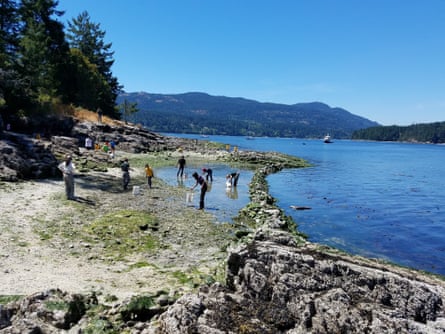
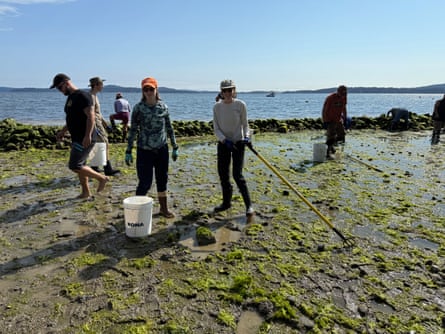
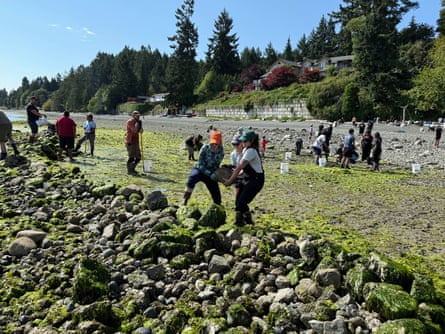
So said Marco Hatch, a marine ecologist at Western Washington University and an enrolled member of the Samish Indian Nation. Hatch has been conducting surveys of mollusks growing in and around clam gardens in the Pacific north-west, as he collaborates with seven Indigenous communities to build or rebuild these rock-walled, terraced beaches once created and tended by their ancestors.
Hatch’s surveys in service of this reclamation are rooted in western scientific methodology and increase understanding about beach ecology and clam health. But, just as important, the data Hatch provides can help these nations obtain the local, state and federal permits they need to maintain or re-engineer these structures. And that helps them assert greater control over their heritage and regain food sovereignty for their communities.
Rather than dismissing Indigenous knowledge, more western scientists are discovering its viability for themselves and adjusting their research goals to embrace it.
That represents a “massive shift”, according to Kyle Whyte, a professor of environmental justice at the University of Michigan and a member of the Citizen Potawatomi Nation. Historically, western scientists have considered themselves rigorous and empirical, while they have classified traditional Native thought as mythic, religious or plain made-up, he said.
In fact, a long-overdue “braiding” of Native and western knowledge is becoming ever more common. Prominent Native authors such as Vine Deloria Jr have pointed out Native environmental practices in books for popular audiences. They’ve theorized, as the Alaskan native scholar Oscar Kawagley described it, “native ways of knowing”. More Indigenous people – Robin Wall Kimmerer, author of Braiding Sweetgrass, is a notable example – are entering academia and changing it from the inside, while some tribal nations have hired their own scientists. Non-Native institutions are seeking to undo their erasure of Indigenous cultures; the Brooklyn Botanic Garden has started to include labeling that highlights Lenape names and uses for food plants like persimmons. International environmental organizations also increasingly recognize the importance of including Indigenous voices in discussions around the climate crisis. Since 2022, there’s even been federal funding to study ways to combine Indigenous and western sciences, so each part remains distinct while being strengthened by the other.
Kisha Supernant, who is Métis and Papaschase and the director of the University of Alberta’s Institute of Prairie and Indigenous Archaeology, said that Indigenous knowledge contained “a rich history of observation, experimentation and understanding that has its own systems of rigor”. Such rigor is evident in places like the clam gardens that Hatch studies. Beginning at least 4,000 years ago, Native communities built clam gardens into the intertidal zone from Washington state through coastal British Columbia, and into south-east Alaska. They are a unique form of mariculture that provide harvestable habitat for an array of tasty ocean creatures like butter clams – collected “in great numbers, then smoked and dried and stored and traded”, Hatch said. But they also yielded red rock crab, basket cockles, sea cucumbers, limpets, sea snails and seaweeds in a veritable smorgasbord for humans and marine mammals, such as otters.
These gardens change where sediment moves and may protect against increasing shoreline erosion; studies also show that clam productivity and populations are higher inside gardens than outside them.
Although there have been instances where treaties affirmed their right to harvest, many Indigenous groups lost access to the beaches where they once picked clams. Hatch facilitates bringing them back to these places, where “sleeping” knowledge of clam gardening – interrupted by such impacts of colonization as privatization of land and forced boarding school confinements – is reawakened. “Memories and stories come up that wouldn’t have otherwise,” as elders remember and then share them with a new generation, Hatch said.
Western science favors distinct disciplines – ecology, biology, geology and Supernant’s specialty, archaeology. But Indigenous knowledge considers “the earth and the water and the air and the plants and the animals as deeply interdependent and interconnected; to understand one is to understand all. And that has a lot to teach western science,” Supernant said of the importance of braiding these systems.
On the flip side, braiding allows western scientists to “use their skill sets to address problems that Indigenous communities [identify]: the fish are unhealthy, or the plants growing in this area are not producing the way we know that they can”, she said. And it can provide a second line of evidence to help Native nations understand what their ancestral foods once looked like and how to reintroduce them to their communities.
Still, the necessity of “proving” the validity of longstanding Indigenous practices can frustrate. Suzanne Greenlaw, a citizen of the Houlton Band of Maliseet Indians, is an ecologist at the Schoodic Institute, a non-profit of the National Park Service (NPS) that supports Wabanaki-led research. She participated in a 2016 study to understand how sweet grass, which grows in salt marshes, rebounds after harvesting. The study was part of a Wabanaki bid to re-establish the right to gather sweet grass from NPS land. Though the Wabanaki have made baskets from sweet grass for centuries, they have been cut off from ancestral marshes in Maine’s Acadia national park for at least 100 years.
Non-Indigenous researchers planned to conduct an environmental assessment to gauge how well plants regrew after picking, choosing sweet grass plots that had no connection to those once used by the community. This led to a comparison study in which Wabanaki practitioners demonstrated their superior understanding of how and where to harvest for the greatest ecological benefit. (They may reclaim harvest rights later this year.)
As opportunities for western and Indigenous collaborations multiply, it’s critical that Indigenous people maintain control over any knowledge gleaned and how it’s used, especially in light of western scientists’ historic penchant for extracting information that suited their own purposes and dismissing the rest. “Western science can help, as long as Native people are still decision makers,” Greenlaw said. She is now involved in a restoration project in Acadia’s freshwater marshlands, to bring back some of the foods that Wabanaki once ate, such as cattails and groundnuts. A team of researchers, including an archaeologist and a palaeoecologist, are using the pollen from core samples to identify relevant species.
“The question from Wabanaki people has been, ‘What is the land telling us? What is the story of the landscape? What is the story of plants that were here?’” Greenlaw said. Data collected by NPS was fractured, an inventory only meant to monitor the health of the marsh and divided among multiple spreadsheets “that didn’t tell a continuous story” of the landscape through time, she said.
The story Greenlaw is helping piece together will aid food sovereignty-focused Wabanaki non-profits determine which plants to restore to their communities and their diets. The question of how governmental permission to eventually harvest these foods will be granted, though, remains unknown. Will Wabanaki be required to conduct environmental surveys and apply for permits to harvest each of these foods individually, as with sweet grass? Or can they be granted the right to harvest from the entire freshwater habitat? “Wabanaki people have been here for seven generations, to caretake the landscape,” Greenlaw said. “The idea that we would harm [it] has not shown up in any examples we can give.”
In fact, there are many proven correlations between Indigenous-managed food systems and ecological health. Researchers at Simon Fraser University have found that when Indigenous groups in British Columbia tended forest gardens, they not only produced an impressive biodiversity of food plants – from crabapple and hazelnut and wild plum to wild rice and cranberries – they also improved forest health.
Whyte, the University of Michigan professor, works with the Sault Ste Marie Tribe of Chippewa Indians in Michigan – one of many Native nations that used prescribed burns to boost populations of sharp-tailed grouse, snowshoe hare and deer, all of which declined after the federal government’s 1911 burning ban. Collaborating with US Forest Service researchers, they conducted more than 20 ecology surveys and other projects that proved their case for fire, in the interest of establishing a co-management plan that would allow them to reintroduce this tool.
“Often in science, you see millions of dollars being invested in [one study] that, at the end of the day, might just produce a very simple result that Indigenous people have known for generations,” Whyte said. “It suggests that if there was more collaboration, we could not only save money, but we could stand on the shoulders of Indigenous people and start doing more advanced studies about the ecosystem.”
What constitutes progress when it comes to braiding western and Indigenous science depends on whom you ask. “If the burden of proof remains on Indigenous communities to demonstrate, using western scientific methods, that their knowledge … is valid, I think we’re not at the place we need to be,” Supernant said. “It is difficult to braid two things together when they’re not given equal weight in the braid.”
But she also noted that Canadian and some US government agencies have made big strides in this merging; in 2019, for example, Canada passed legislation that requires the consideration of Indigenous knowledge when it comes to making regulatory decisions in areas like fisheries management.
Whyte is encouraged that the Intergovernmental Science-Policy Platform on Biodiversity and Ecosystem Services (IPBES), which seeks to provide scientific evidence to inform government decision-making, included a chapter on Indigenous knowledge in its latest global assessment. But he sees plenty of opportunity for improvements to braiding. For starters, “Indigenous people need to be involved at the earliest stages of research,” he said. And that means western scientists “need to get into the habit of approaching potential [Indigenous] partners and saying ‘I’m interested in water. Are you interested in water?’ before any research questions have been created. Let’s just get excited together about the topic, and plan from the beginning.”
He would also like to see more Indigenous people initiating their own research – something the Sault Ste Marie have begun to do by establishing the Center for Cooperative Ecological Resilience. “They now reach out to western scientists and collaborate with multiple universities,” Whyte said.
In Hatch’s experience, when Indigenous knowledge holders and federal land managers can meet with “the singular goal of reconnection to place, and reactivating [clam garden] technology, a lot of relationships are strengthened, and those connections are sprouting into new areas,” he said. He’s seen greater interest and community building among Indigenous and non-Indigenous people alike, with park department employees, neighbors, students and local businesses convening to learn and share. After all, he said: “The beach is a great place to connect.”