.png) 8 hours ago
4
8 hours ago
4
Welsh National Opera might be marking its 80th year, but any feelgood factor is decidedly absent from their season-opener. Bartók’s only opera and Stravinsky’s opera-oratorio form a challenging double-bill: serial murders, patricide and incest, blood and more blood, but gripping performances made this a powerful experience.
Béla Balázs’s libretto for Bluebeard’s Castle transformed the Perrault fairytale and its happy ending into an intense psychological drama: the castle with its weeping walls and seven locked doors a metaphor for the secret inner workings of the male psyche, and Judith, Bluebeard’s new wife, his fourth, the archetypal woman, too curious for her own good.
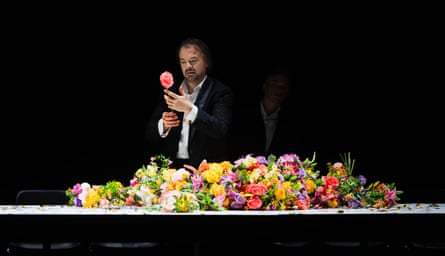
In this staging first seen at English National Opera in 2024, director Joe Hill-Gibbins tightens the focus even more sharply so that the castle doors and its keys are also metaphorical, with LJ Parkinson’s Bard – the shamanic regös (narrator) of Hungarian tradition – offering the signature contents of the hidden rooms. Cutlery for weaponry, treasury gold thrown about in sweeping gestures, bouquets of flowers, all are tailored – both to the intricacies of the score and to the setting of the single long table – to mirror the emotional wrangling as, one by one, Judith demands that the doors be opened. The feat of Christine Rice’s expressive Judith and Nathan Berg’s implacable Bluebeard is to create an intimacy as palpable as the unfolding horror.
By way of preface to Bartók’s dark symbolism, and in a departure from the ENO version, the women of the WNO chorus, ghostly presences in white, intoned the antiphon O Rubor Sanguinis and the responsory Rex Noster Promptus Est of Hildegard von Bingen, redolent of the blood of martyrdom and of innocents. Their emergence as the final door is opened identifies them as Bluebeard’s previous wives in their wedding finery, 14 all told. But here again, this production departs from the norm, since Judith does not join them – she is condemned instead to live an eternal hell with Bluebeard. His final utterance, “darkness”, with its tritone, the devil’s interval, spells the impossibility of redemption.
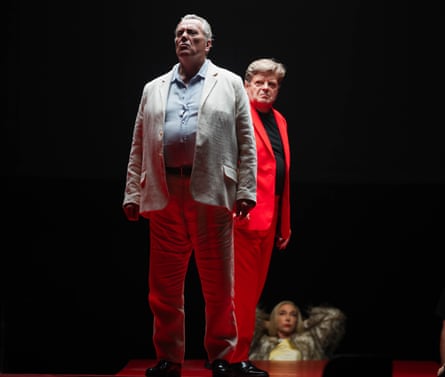
Hill-Gibbins’s Oedipus Rex is new and, using the full width of the Millennium Centre stage and a formidable 35-strong male chorus embodying the force of the Theban populace, lends a scale that fulfils Stravinsky’s aim of a classical monumentality, reinforced by the Latin translation of Jean Cocteau’s original text. The crushing weight of fate is always present, everything stark black, save for a huge half-globe of light – its dazzle sometimes rendering the surtitles invisible – the bright glamour of Rice’s impassioned Jocasta and the blood-red suit of Peter Hoare’s Oedipus. Hoare, in total vocal command, conveyed convincingly the gradual disintegration of kingly mien, slow to realise the awful truth that he did indeed kill his father and marry his mother, finally inflicting on himself the ultimate dark of blindness.
For all the ritualistic element, nothing was static, with arguably too much running around and crawling, and some of Parkinson’s narration was under-projected. But, bound by the authoritative conducting of Lidiya Yankovskaya, who brought Bartók’s eloquence to the fore, and found playful moments as well as grave solemnity in the Stravinsky, this was strong stuff.