.png) 3 months ago
66
3 months ago
66
The brick house Sylvia shares in a Western Cape township on the outskirts of Cape Town with her three children gets unbearably hot every summer, causing the youngest to cry and her two older children to struggle to concentrate on their homework. Sylvia is not alone, according to a recent report in the Lancet: “In 2024, people in South Africa were exposed to 13 heatwave days, on average. Of these, 10.5 (80%) would not have been expected to occur without climate change.”
But summer is more bearable for the family now that her asbestos roof has been painted with reflective paint.
“It’s still hot,” says the 49-year-old single mother from Khayelitsha, the largest township in the city. “But we have our house cooler now and can comfortably be indoors when there is the scorching sun outside. My children sleep better. For me, that means everything.”
The evidence is not only anecdotal: temperature data over three summers from 240 houses across Africa reveal that those with painted roofs are on average 3-4C cooler during the hottest time of the day. A pilot project – the heat adaptation benefits for vulnerable groups in Africa (Habvia) – has collected testimonials that the participants in cooler houses are sleeping better too.
“Better sleep isn’t just a nice-to-have,” says Lara Dugas, an epidemiologist who, along with climate scientist Mark New, are Habvia’s principal investigators. “Bad sleep has poor mental health outcomes, poor disease outcomes, and makes diseases that are already present, like hypertension, much worse.”
It would usually take decades to make the scientific link between hotter houses and illnesses such as diabetes and cardiovascular disease, but disrupted sleep patterns are a canary in the coalmine.
“We know that poor sleep leads to worse health outcomes,” says Dugas, citing a large body of work, including her own, investigating this relationship in the US, Jamaica, Ghana, Seychelles and South Africa.
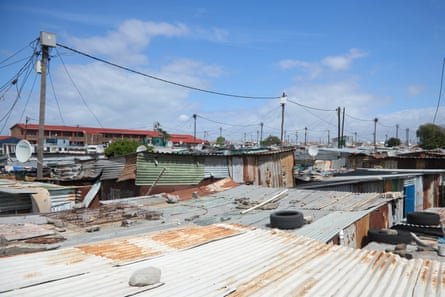
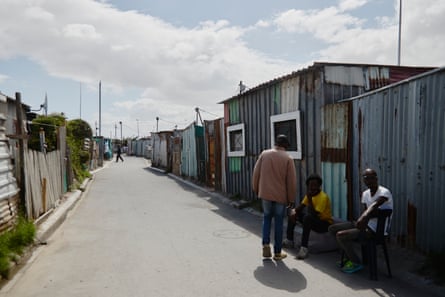
Sylvia’s home is one of 30 in Khayelitsha whose roof was painted. A control group of 30 unpainted houses in the township were used as a comparison. Habvia is also being carried out in three other communities across Africa: Mphego village in rural South Africa, and Ga-Mashie and Nkwantakese, in urban and rural Ghana respectively, using the same methodology.
The goal is to understand the health benefits of specialised reflective roof paint in different contexts (rural v urban) and climates (temperate v high heat and humidity).
Habvia is one of nine projects in the Wellcome Trust-funded HeatNexus. “The initial grant call was to evaluate existing heat adaptation interventions in low- and middle-income settings,” says Dugas. “But we quickly discovered that there were no existing interventions in Africa to evaluate.”
So, they decided to create their own, and settled on roof paint, choosing a South African product, Rhinoluxe Heat Reflect, an “infra-red reflective roof paint” made for commercial and agricultural buildings, such as chicken coops. “The paint had to be locally manufactured,” says Dugas.
“Eventually we want to paint millions of roofs, so price and local sustainability are a big deal.”
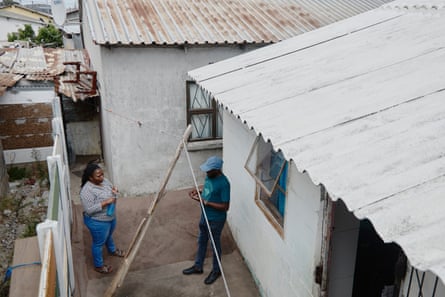
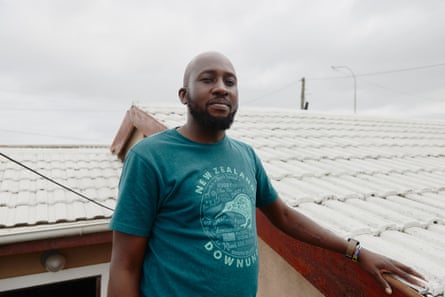
Two years on, the roofs have all been painted. “There are so many factors to consider when comparing indoor temperature data,” says postdoctoral researcher Vuyisile Moyo, perched on a wobbly municipal bin to inspect a corrugated-iron shack’s roof.
“What are the walls made of? What’s the roof made of? Does it have a ceiling? How many people are sharing the space?”
Moyo is chiefly concerned with people’s experiences, while his laptop-toting colleague Ebrahim Behardien is collecting environmental data. For the past three summers, they have spent three days a week walking around Khayelitsha, along with Monwabisi Tyunthu, a research assistant who lives in the township. While Moyo and Tyunthu conduct interviews, Behardien downloads temperature data from iButtons (a sensor smaller than a penny that hangs on the wall in each home) and air pollution readings from another, slightly larger, device.
Moyo and Behardien have forged bonds in the community. Through the course of their work, they chat with people taking part in the scheme and their neighbours. On the day the Guardian visited, they called on the family of a 49-year-old participant who had died the previous week. The visit is emotional: Behardien and Moyo are given the best chairs in a tiny room crammed with a dozen relatives, aged from two to 62, as they reminisce over a shared bottle of Fanta.
Back at Habvia headquarters in a leafy Cape Town suburb, research assistants Nandi Sinyanya and Tabitha Cetyiwe are doing health checks on three women taking part in the project. Having fasted to prepare for tests, including blood glucose, urinalysis and blood pressure, the women enjoy a sandwich and a cup of tea. They are fitted with sleep and physical activity monitors, as well as a core body temperature sensor, which will record data over the week.
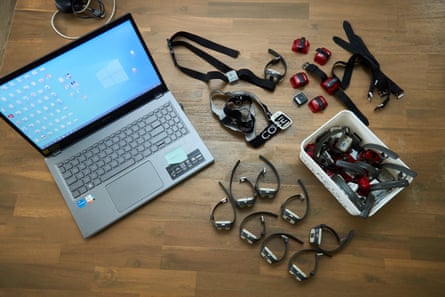
Everyone taking part in the project across all four sites undergoes these tests three times each summer. “Anecdotal evidence only gets you so far,” says Dugas. “Someone can tell you they slept badly when it was hot, but it is important to quantify just how bad is bad?”
Dugas, who has spent most of her career focused on obesity, says Habvia has opened up new avenues. “It has been especially rewarding doing work with a direct and measurable impact,” she says. “When you paint a roof you can change people’s lives in an instant.”
One man waiting for change is Bongani, a 42-year-old from Khayelitsha. “Heat is the worst part of my day,” he says. “Our zinc houses trap heat even into the night. We can’t sleep properly, and you wake up already exhausted. The heat makes me feel tired and angry, and sometimes I cannot even think straight. My roof has not been painted yet, but I sometimes visit a friend whose roof has been painted. It is cooler there, and when it’s too hot, I prefer going to sit at his house.”
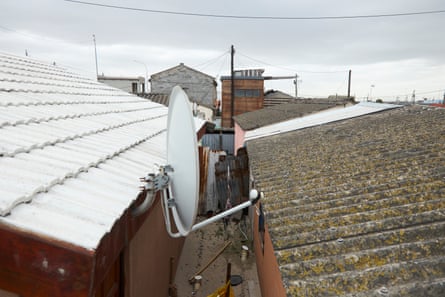
He adds: “Painting the roofs may seem like a small thing, but for us, it changes how we live.”
Hopefully this will only be the beginning. “In an ideal world, every one of these roofs would be painted,” says Moyo from his vantage point on another wobbly bin in a different corner of Khayelitsha. “But we should start by painting schools and clinics.”
* The study’s participants asked to be identified by their first names only.