.png) 8 hours ago
5
8 hours ago
5
It’s March 1981 and Madness are revisiting the haunts of their recent youth with a film crew in tow. In the 18 months since releasing their debut single, The Prince, the group have become the UK’s most beloved hit-makers, their ascent abetted by inventive music videos that have left viewers of Top of the Pops and Tiswas believing a man could fly – while blowing a sax.
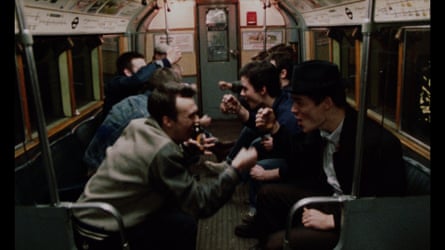
But this new project is something else. Instead of squandering their newfound wealth on fast cars and country piles, the seven-piece have invested in a semi-fictional big-screen telling of their origin story that tempers their trademark “nuttiness” with a kitchen-sink realism suiting their working-class roots. While Take It or Leave It sank into obscurity soon after release, a new 4K restoration has primed the film for rediscovery as a time-capsule of grimy 70s London, and perhaps cinema’s most honest depiction of the challenges involved in trying to get a band together.
The movie was the brainchild of Dave Robinson, honcho of Stiff Records. Back in 1979, Robinson triumphed in the bidding war for Madness, then in their late teens and early 20s. “There was a special connection,” the charismatic Dublin-born mogul says today. “To them I was ‘Uncle Dave’.”
Robinson recognised Madness as more than just prodigiously talented musicians and songwriters. “We were these different characters, jumping around and clowning about, like kids at school showing off,” says keyboardist Mike Barson. “Dave encouraged that.” Uncle Dave intuited this energy would flourish in the embryonic music-video format, hiring Chuck Statler – who’d made memorable clips for Devo and worked quick and cheap – to film Madness’s first promos. Dave took over the reins for 1980’s My Girl, working even quicker and cheaper. “I was also running a record label,” he says, “so we’d have to get the videos done in a day.”
But Robinson never compromised his youthful charges’ imaginative approach. Saxophonist Lee Thompson tested the label-owner’s impressive ability to “make things happen” with 1980’s Baggy Trousers. “I told Robbo I wanted to play sax while flying through the air,” says Thompson, who arrived at the shoot to find Robinson had booked a forklift and kirby wire. The resulting stunt became part of the group’s iconography.
When Robinson began work on Take It or Leave It, he says, “people told me it couldn’t be done, that we were mad”. He tapped the band members and manager John “Kelloggs” Kalinowski for £20,000 each (“the price of a fuckin’ two-bedroom in NW5 back then”, says Thompson), covering the rest of the budget himself. “I had planned to shoot it in a week,” he says. But when Robinson arrived on set the first day he was greeted by “50 guys staring at me, eating bacon sandwiches”. Unlike the videos, the movie was “a unionised shoot”, and Robinson sensed this crew would slow him down. “I had to get rid of them. I paid them all off and they never turned up again.”
Crew purged, he returned to his “typical smash-and-grab, guerrilla-film-making methods”. Frontman Graham “Suggs” McPherson remembers tracking shots being filmed “by a cameraman in a trolley or on a bicycle”; overhead shots involved “someone hanging off a stepladder”. Robinson rarely sought permission to shoot locations, guitarist Chris Foreman describing their mindset as “do it quick enough and they can’t tell you to stop. By the time some jobsworth comes along, you’ve already finished.” It was a vibe they’d learned as teenage delinquent graffiti artists.
Unsurprisingly, Madness took care of the soundtrack, covering Elvis Presley and Fats Domino tracks – often poorly, on purpose, to suggest the roughness of their first incarnations – and performing their own songs during scenes replicating early gigs. They also cut new songs such as Don’t Look Back, a funk track heard during a party scene, and co-wrote the script – what there was of it.
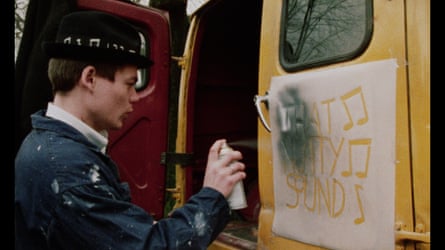
Before production began, Robinson interviewed the group about their early days, boiling his research down to 30 scenes that told the Madness story. On set, the band members would ad-lib these scenes with “great older actors” Robinson had hired to play authority figures. His cast were, he says, “all naturals”. McPherson remembers Robinson screening “Kes, Bronco Bullfrog, Mean Streets and some British kitchen-sink dramas, to get that vibe of just being ourselves”. He also took them to see Raging Bull, Thompson adds, which was “an eye-opener: black and white, grainy, gritty, real. Dave wanted that as our inspiration.”
Realism was paramount. Robinson filmed scenes where they’d actually happened: shabby rehearsal rooms; legendary Camden hostelry The Dublin Castle; the Crouch End home of Mike Barson’s mum, where the group first formed. “Dave used cameramen who’d worked on documentaries,” says bassist Mark Bedford, “and the film was close to a documentary – most things had really happened.”
“We’d done all these psychedelic videos,” McPherson adds, “but our aim now was to capture the dreary reality of forming a band.” The first 20 minutes of the movie are in black and white, he says, “because London felt fuckin’ black and white in the late 70s”. There’s little of the manic visual invention of their music videos, although a set-piece where Thompson drives a van into a low bridge during brief, ill-fated employment on a building site is a masterpiece of comic pacing. A plan for the streets to turn into marshmallow after a wild night out was nixed due to budget – and a worry this family-friendly band shouldn’t let on that some members enjoyed psychedelics.
Nevertheless, Take It or Leave It is a very funny film, much of its comedy coming from Barson. “Mike had a role he could sink his teeth into: the bad guy,” says Foreman. As the sardonic ringleader of this unruly circus, he excoriates band members for bum notes, bad attitudes and, in McPherson’s case, ditching rehearsal to go see his beloved Chelsea FC. Barson’s abrasive manner, which Bedford says was “slightly exaggerated” for the film, sees off McPherson, Thompson and vocalist/trumpeter Cathal Smyth for brief periods, although everyone agrees that without Barson’s “doggedness”, the band would never have made it. “Mike was the engine,” says Bedford.
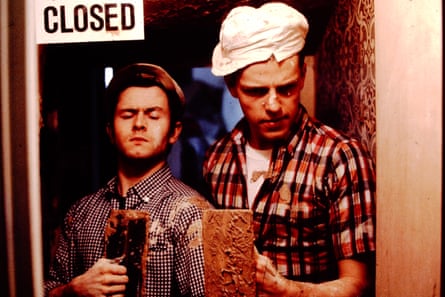
Throughout, there is a sense that this beloved pop-cultural institution might easily have never happened, for all the everyday, low-drama reasons so many bands implode: internal ructions, the interminable juggle of creative ambitions and real-life responsibilities – and the eternal struggle to find a decent drummer. When the lineup finally coalesces and the artists formerly known as the North London Invaders rehearse as Madness for the first time, it makes for electrifying cinema.
Not least because of the stakes at play. Throughout the film, it’s clear the youthful Madness aren’t Brit School graduates or posh kids slumming it before taking a job at daddy’s firm. Thompson can’t get saxophone lessons because his horn is stolen and its serial number has been rubbed off. Suggs’ chronic truancy and misbehaviour solicit the unwelcome attention of social services, looking to remove him from his mum’s care. One gig ends with an ambush by skinheads in the toilets, the band narrowly escaping a clobbering in their Morris Minors.
On the commentary track for an earlier DVD release, Robinson said: “The system didn’t know what to do with young lads who weren’t nasty but were just trying to have a laugh.” Today, he reckons “being in Madness kept some of these lads out of jail”. The film reveals an edge that wasn’t obvious while the group was clowning with Tiswas’s Phantom Flan Flinger, but surfaced on grittier songs like Embarrassment, Overdone and Not Home Today.
“I was at a crossroads,” nods Thompson, whose dad had been in prison multiple times. He remembers wondering, “‘Do I stick with the band, or hang around the bus stop sniffing glue?’ The pal who got me my saxophone, he was later stabbed to death in the Music Machine.”
Barson’s crossroads moment is depicted in the film, although it’s played as fantasy, he and friend Si Birdsall discovering neon tube-lights, wielding them like light-sabres and evading the coppers. In reality, they actually got caught smashing lightbulbs by transport police and were sentenced to three weeks at Wormwood Scrubs. En route to prison, his police van passed Buckingham Palace, and he saw the bus he used to ride into central London.
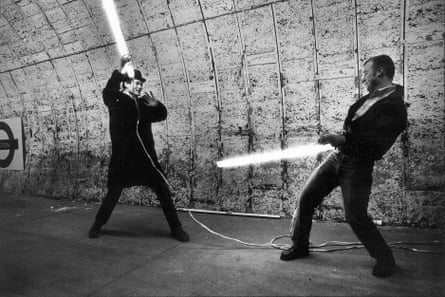
“I thought, ‘If I was free, I could get on that bus, go home and make myself a cup of tea. But now I’m wondering if they’re going to strip-search us and hose us with disinfectant when we get there.’ I was scared. After that, I pulled back from hanging out with them kids who were into wild, aggressive things and put that energy into music. Years later, in 2012, we played on the roof of Buckingham Palace and the queen waved up at us.”
“We were all on a spectrum of petty criminality, growing up in an environment of violence,” says McPherson, “though none of us had that thing where you’ve been beaten into wanting to hurt other people. There was a crossroads where some in our gang were definitely going criminal, and we were the artistic side of that coin. Criminality boils down to: are you prepared to shoot someone? And no, I’m not. I don’t think I had the guts for it. The band was our way out.”
Ultimately, the shoot took longer than a week: memories vary, but somewhere between a fortnight and a month. Robinson broke his foot midway through but says: “At the end, we all clapped each other on the back and said, ‘We got away with it!’ We were thinking it’d go on the art film circuit. But it played in one cinema in Camden and that was it. We didn’t get a big campaign from the distributor, which it needed.”
Although the Guardian’s Derek Malcolm gave the film a positive review, and a VHS release sold well to the Madness faithful, Take It or Leave It was quickly forgotten. A couple of years later, after their guest appearances on The Young Ones, that show’s creatives, Ben Elton and Richard Curtis, filmed a pilot for a proposed Madness sitcom. “The premise was that we ran Britain and had to solve some big problem every week,” remembers Foreman. “ITV were interested, but we were holding out for the BBC. Then Mike left the group, so it came to nothing.”
Later, McPherson auditioned for Julien Temple’s Absolute Beginners, but broke his big toe while training with the choreographer. “So that was the beginning and the end of my film career,” he sighs, though he doesn’t really sound very disappointed. “Madness was always my priority,” he explains, “and I’m so glad. If I’d gone into acting, I’d never have achieved everything I did with the band. You can’t have it all.”
While he never made another film, Robinson is still active, organising benefit concerts for the children of Ukraine. Madness released their 12th album in 2023 and recently completed a summer tour. The restoration has them reflecting on their movie, and the passage of time. For Barson, four-and-a-half decades have caused reality and near-reality to blur. “When I try to remember what really happened, I get stuck on how it happened in the film,” he says. “The reality has become inaccessible because that film gets in the way.”
The film is now a time capsule for a bygone age: the band comment longingly on machines on the tube selling 40p tickets and the ability to park your car wherever you wanted. Other memories are more heartfelt. “Gary Bovey, who was briefly our drummer and played himself in the film, was a good friend of mine,” says Bedford. “He died a few years ago, and it’s amazing to see him on screen, speaking and being himself.”
“I was so disappointed with the film when we finished it,” adds McPherson. “I thought it was prosaic and boring. But now – it’s just so charming. We were friends, most of us, before the band started, and we are good friends now. To see our story up on screen makes me very proud. I love those guys. I fucking love them.”