.png) 4 hours ago
7
4 hours ago
7
Astronauts on the historic Artemis II mission are expected to reach the far side of the moon on Monday, venturing deeper into space than any humans before.
Nasa has reported satisfaction with progress toward the lunar fly-round since the team’s launch on Wednesday, with the three Americans and one Canadian on course to break the record for maximum range from Earth just as a total solar eclipse awaits.
“The Earth is quite small, and the moon is definitely getting bigger,” the pilot Victor Glover reported after Artemis fired a key thruster to exit Earth’s orbit.
The crew are the first astronauts bound for the moon in more than half a century, picking up where the Apollo programme left off in 1972.
While the mission is already sending back valuable data and images, the crew have reported persistent problems with one of the Orion capsule’s most crucial pieces of equipment: the toilet.
Until the lunar loo is fixed, mission control has instructed the astronauts to continue using backup urine collection bags. The commode malfunctioned after Wednesday’s liftoff and has only been working sporadically since then.
Engineers suspect ice may be blocking the line that is preventing urine from completely flushing overboard. (The toilet is still open for No 2 business.)
A version of the Artemis II toilet was tested on the International Space Station several years ago but remains prone to dysfunction.
Debbie Korth, the deputy manager of Nasa’s Orion programme, said the astronauts had also reported a smell coming from the bathroom, which is buried in the floor of the capsule with a door and curtain for privacy. “Space toilets and bathrooms are something everybody can really understand … it’s always a challenge,” she said, noting that the space shuttle toilet was also often on the blink.
John Honeycutt, the chair of the mission management team, said he wanted the facilities working reliably for the crew. “They’re OK,” he said of the astronauts. “They trained to manage through the situation.”
The astronauts woke on Sunday to the tune of pop star Chappell Roan’s inclusivity anthem Pink Pony Club and kicked off their day with a breakfast of scrambled eggs and coffee.
“Morale is high onboard,” the commander Reid Wiseman told Houston’s mission control centre as the work day began after speaking with his daughters from space. “We’re up here, we’re so far away, and for a moment, I was reunited with my little family,” he told a live press conference. “It was just the greatest moment of my entire life.”
The US space agency published an image taken by the Artemis crew that showed the Orientale Basin – sometimes known as the moon’s “Grand Canyon”. Speaking to Canadian children live from space, the astronaut Christina Koch said the crew was most excited to see the basin, which resembles a bullseye.
“It’s very distinctive and no human eyes previously had seen this crater until today, really, when we were privileged enough to see it,” Koch said during the question-and-answer session hosted by the Canadian Space Agency.
The astronauts have had geology training in order to be able to photograph and describe lunar features, including ancient lava flows and impact craters. They all had to memorise the moon’s “big 15” – the 15 features that would allow them to orient themselves.
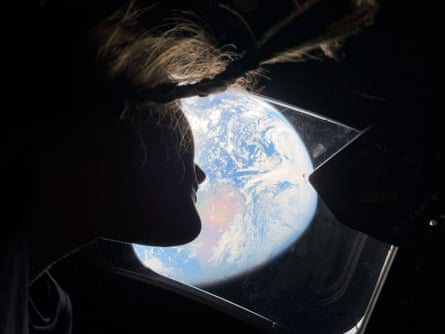
The space agency had previously released images from Orion that included a full portrait of Earth with its deep blue oceans and billowing clouds.
The next significant milestone is expected overnight Sunday into Monday, at which point the astronauts will enter the “lunar sphere of influence”, where the moon’s gravity will have stronger pull on the spacecraft than Earth’s.
If all goes smoothly, as the Orion spacecraft whips around the moon, the astronauts – the Americans Glover, Koch and Wiseman along with the Canadian Jeremy Hansen – will have travelled further from Earth than any human before.
Apollo flights of the 1960s and 70s flew about 70 miles above the lunar surface, but the Artemis crew will be just over 4,000 miles at their closest approach, which will allow them to see the complete, spherical surface of the moon, including regions near both poles.
During the flyby, which will last for roughly six hours, the crew will have to observe the celestial body with their naked eyes, along with cameras they have onboard. The journey promises views of the moon’s far side that were too dark or too difficult to see by the 24 Apollo astronauts who preceded them.
Apollo 13’s astronauts missed out on a moon landing when one of their oxygen tanks ruptured on the way there in 1970.
The Artemis II mission is part of an ambitious plan to repeatedly return to the moon, with the goal of establishing a permanent lunar base offering a platform for further exploration.
Nasa is aiming for a landing by two crew members near the lunar south pole in 2028.
The Associated Press and Agence France-Presse contributed to this report.