.png) 3 months ago
54
3 months ago
54
Argentina’s congress has approved a bill promoted by the libertarian president, Javier Milei, that authorises mining in ecologically sensitive areas of glaciers and permafrost, outraging environmentalists.
The amendment to the “glacier law”, which was already approved by the senate in February, would make it easier to mine for metals such as copper, lithium and silver in frozen parts of the Andes mountains.
The chamber of deputies, Argentina’s lower house of congress, approved the amendment with 137 votes in favour, 111 against and three abstentions after nearly 12 hours of debate. Environmentalists say the legislative changes will weaken protections for crucial water sources.
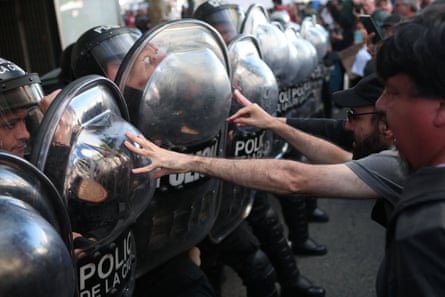
Thousands of people protested outside parliament on Wednesday in a demonstration marked by isolated skirmishes with police. Some held banners with slogans such as “Water is more precious than gold!” and “A glacier destroyed cannot be restored!”
Seven Greenpeace activists were arrested earlier in the day after scaling a statue outside parliament and unfurling a banner urging lawmakers “not to betray the Argentine people”.
The passage of the amendment is a new coup for Milei, who pushed through looser labour laws in February despite repeated street protests. Nicolás Mayoraz, an MP from Milei’s ruling La Libertad Avanza party, assured lawmakers that combining “environmental protection and sustainable development is possible”.
The environmental activist Flavia Broffoni said after the protest: “The science is clear … there is absolutely no possibility of creating what they call a ‘sustainable mine’ in a periglacial environment.”
There are nearly 17,000 glaciers or rock glaciers, a mix of rock and ice, in Argentina, according to a 2018 inventory. In the north-west, where mining is concentrated, glacial reserves have shrunk by 17% in the last decade, mainly because of climate change, according to the Argentine Institute of Snow Research, Glaciology and Environmental Sciences.
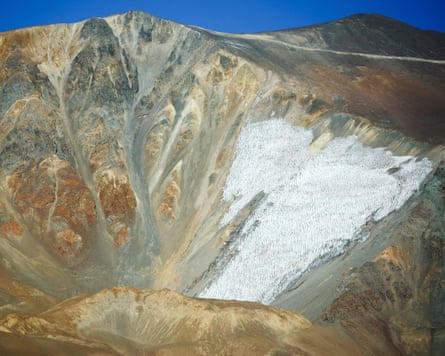
Milei, a free-market radical who does not believe in human-made climate change, says the bill is necessary to attract large-scale mining projects. Argentina is a major producer of lithium, which is critical to the global tech and green energy sectors.
The Central Bank of Argentina has estimated, based on industry forecasts, that the country could triple its mining exports by 2030. Milei has argued that: “Environmentalists would rather see us starve than have anything touched.”
Supporters of the bill argued that it would clear up ambiguities in the existing law, dating from 2010, on which periglacial areas – areas on the edges of glaciers – could be developed economically. “We want legal certainty, we want clear definitions,” said Michael Meding, the managing director of the Los Azules copper mining project in San Juan province.
Enrique Viale, the president of the Argentine Association of Environmental Lawyers, said the change in legislation threatened the water supply for 70% of Argentinians.
Under the existing law, a scientific body designates protected glaciers and periglacial environments. The new legislation would give individual provinces more powers to decide which areas needed protection and which could be exploited for economic purposes.
It has been backed by the governors of northern Andean provinces with strong mining sectors, namely Mendoza, San Juan, Catamarca and Salta.