.png) 3 months ago
40
3 months ago
40
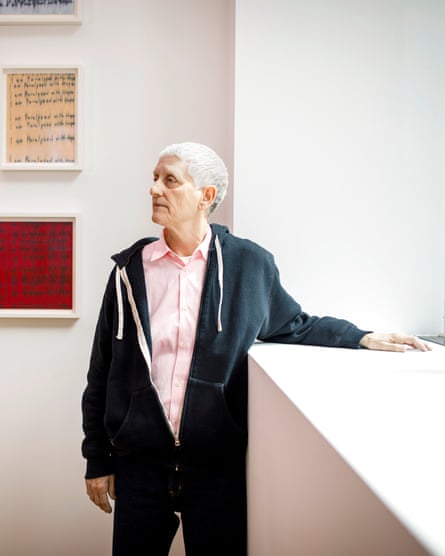
A few weeks ago, Roni Horn, 70, was removed from her flight, just before takeoff from the US to Germany. A male steward was so irritated when he asked her to adjust her seat – and she politely refused to move it any further, since it was already as upright as she could get it – that he had the flight stopped and Horn was escorted off, where she gave a report to stunned police. “I was in business class, just for context,” she says.
The artist and writer went back home, to the island on Maine where she lives, and cancelled the first part of her European trip. That was two weeks ago. Then she flew directly to London, in time for her first solo exhibition here in a decade – Seizure of Hope at Hauser and Wirth.
Horn rarely answers questions directly – she likes ambiguity. I think she’s telling the story not because “it’s good for my image”, as she jokes, characteristic of her quietly subversive, rebellious attitude, but because it reveals something of how she experiences the world, as an androgynous person who doesn’t fit in a box, especially in Trump’s America. Horn’s art is like this – serenely anti-authoritarian, revelling in the absurd and the contradictory. The unpindownable nature of her work, playful in form and mutable in materials, including photography, drawing, sculpture and film, is where it gets its vitality. It has a presence without ostentation, much like Horn herself.
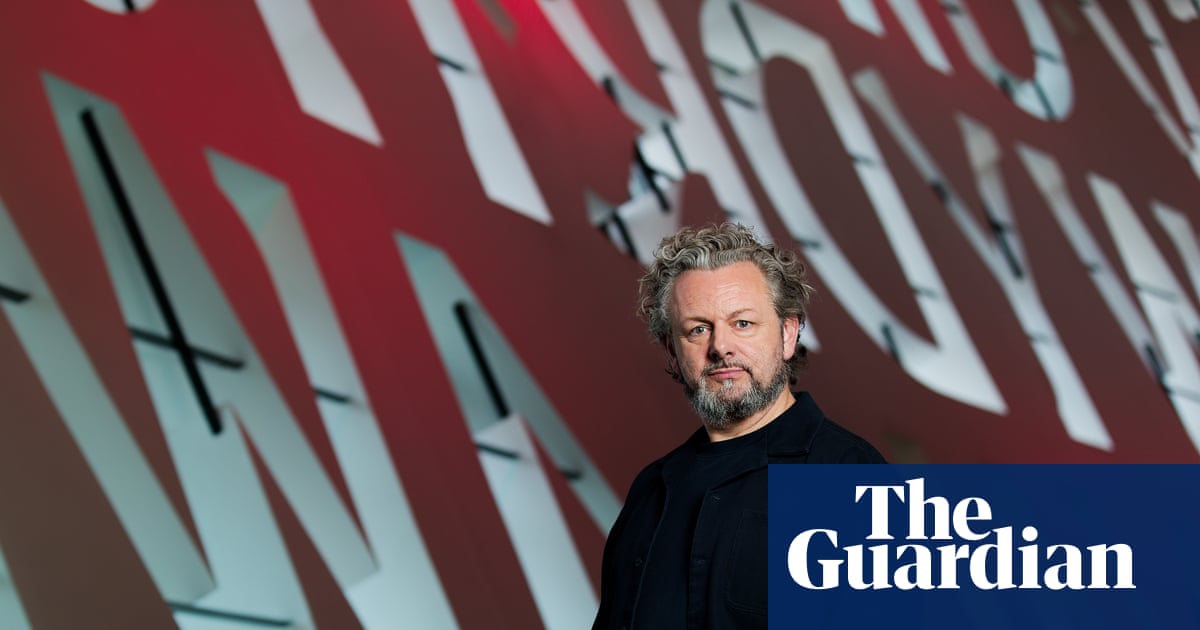
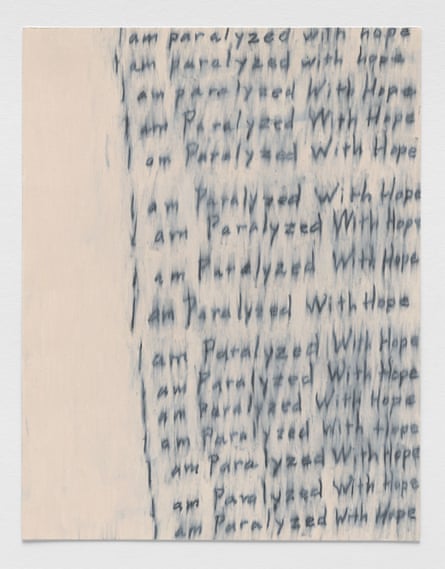
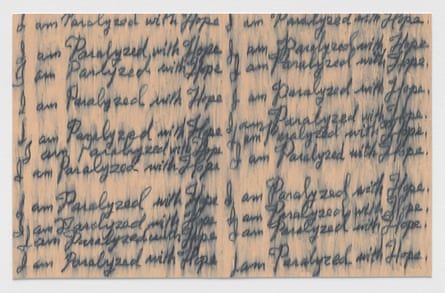
Stepping into the gallery on Savile Row, at first it doesn’t look like much: 80 drawings, rendered in “very, very soft” graphite pencil with wax pencil, reiterate the same handwritten phrase, “I am paralysed with hope”. What you notice as well as the words, which create an echo around the spartan room, is the spaces in between the frames – uneven gaps, lacunae, ellipses – where meaning slips and falters. Last night, Horn was left here alone and switched some of the frames around at the last moment. “It’s all intuitive,” she says of the meticulous installation. “Things do have their scale, though that’s been heavily distorted in contemporary culture where bigger is better. This feels like a significant number, but it isn’t wallpaper.”
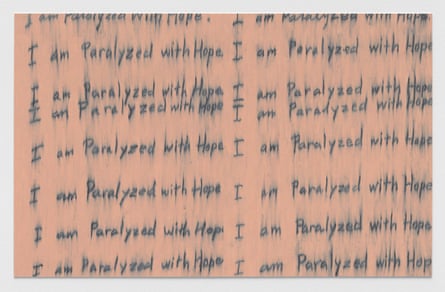
Mirroring, doubling and repetition are constants in Horn’s work. These drawings are mired in midnight madness. She describes them to me as “an endless silent scream feeling. I’ve lost a lot of friends and one of the things that comes up a lot when you’re very ill is that the last thing to go is hope.” This is the reason why, after she’d heard it in comedian Maria Bamford’s routine in 2020, she became so attached to the phrase “I am paralysed with hope”.
“It started around the time of the political downfall of America,” Horn says. “I’d come home at night and this quote stuck with me, I couldn’t it off me. It was like that scene in Alien when the Facehugger gets stuck to John Hurt’s face – it feels like there’s a little bit of horror. Every evening I would have to do this work, even if there was something else going on. There was a point when I thought I needed to move on but I was never ready to move on.”
The phrase has appeared in previous works, including LOG, an epic, conceptual diary made over 14 months during lockdown. It was also the title of her exhibition at Centro Botin in 2023. The drawings are smudged in places, making them feel urgent, and the style varies – “I was always told my handwriting was atrocious,” Horn tells me. “Banks would ask me for multiple signatures, just to make sure they have it covered.”
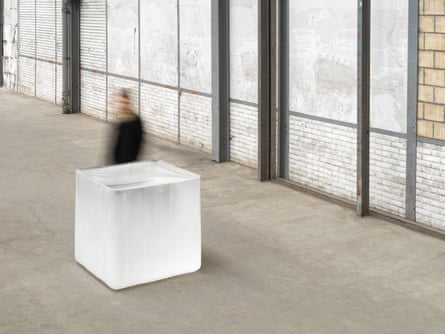
In the room with the drawings, there’s also a solid cast glass sculpture – Horn has been making them since the 1990s – that resembles a very large ice cube, clear and square. Its title is cribbed from Bertolt Brecht – What Happens to the Hole When the Cheese is Gone?
“I loved the idea of this hole that disappears,” Horn laughs. The title is intended as a gentle positioning for the work, which could really mean anything – and that’s what Horn wants. The cube catches the shadows and the light, changing constantly while never moving. The works are made by pouring molten glass into a mould, which hardens slowly over months, and the top is fire-polished – the final piece is in fact an ambiguous state too, glass being a liquid that appears solid. It’s the perfect articulation of Horn’s insistence on staying in the unknown and the in-between.
We linger on the sculpture – the title, she explains, is a nudge, not a sledgehammer – it doesn’t have “anything to do with the work, but I’m not fighting it actively, I could dry it out to a crisp and just call it untitled, but humour is very important to me.” She says critics have tended to overlook this aspect of her work. “Or maybe it was just bad humour”, she smiles.
It’s not bad humour, but maybe it’s niche. The way her brand of conceptual art, too, is more of a slow-burning thing. She never resolves anything for the viewer, and this exhibition might leave viewers feeling a little less sure of the status quo. And that’s no bad thing.
The drawings remind me of lines chalked on the blackboard as punishment – was this some kind of enactment of self-flagellation? “No – it made me feel present. When you feel all your values are being eroded, and of all the things affected by that erosion, in my case, weather and nature, you never stop thinking about those things, you never stop feeling them in your body. When I was executing these drawings, I was able to get in a zone that was not so oppressive to me as just breathing the air.”
The more you sit with the phrase that scrawls along the gallery walls, the more you think about ideas of shock, seizure, paralysis, the more it turns you towards the body – political sickness devolving into physical sickness. The last few years, she adds, have “been so toxic, not even getting into the politics – a year ago they found PFAS plastics in the rainwater, so it’s entered that cycle – and you can’t get away from that, you can’t really take care of yourself any more, they’ve taken that way from you, the ability to make choices based on knowledge.”
It must be challenging, I suggest, to keep creating any kind of art, against all of this. “Now add to that the horror of people’s incivility and inhumanity, the loss of all sense of proportion, to put it mildly – all of that goes away when I’m working, and this one sentence was so meaningful to me. That’s why I call it seizure, I’m literally frozen in space, stick with it and it’ll be OK.”
Horn tells me another story, about one of her many solo trips in Iceland. “It was very cold, I was on the motorcycle, the roads were really bad, it was kind of raining, and I was singing Hank Williams, you know, ‘I’m so lonesome I could cry’”, she recalls. “Then I lost control, and I drove off the road. The only time I’ve ever driven off the road, and I landed in a lake, on the motorbike, and I’m standing there thinking, fuck. It was so shocking – the motorbike was still running. So I just drove out of the lake, but it was traumatising. I spent the night just being traumatised by this memory but what I focused on at the same time was that this was just the most mundane act, that somehow I had lived my life not having this experience.”
There’s a surprising, unexpected but essential glimmer of optimism in this exhibition. “With all the trouble that I’ve had – not more or less than anyone else but the routine of what it is I’ve lived through, I feel very lucky,” Horn says wistfully. “And I always take my luck personally.”
This is what Seizure of Hope is also about – the near-misses, a shock to the system that steers us out of the frozen lake.