.png) 2 months ago
58
2 months ago
58
Craig Munns has a large model of a T rex on his desk. He got it with a magazine subscription two decades ago. One day, a few years ago, he was sitting in his study, which was dense with books and yellow sticky notes and posters charting evolution from single cells upward, and he thought, “What am I going to do next in my life?” And his eyes lit upon the T rex.
Munns had recently taken on a job at the public library in Canberra, but it had always rankled with him that he had not studied for a degree, starting instead as an electronics trainee after he left school in Sydney, Australia. So he decided to enrol as a part-time student. He graduated at 62, with honours in palaeontology from the University of New England in Armidale, NSW.
Now 65, Munns works at Geoscience Australia, a government agency that conducts geoscientific research. His main task is monitoring mineral deposits, but he sounds most animated when he talks about a palaeontology paper he is working on, about two drill cores – long tubes of rock – which were extracted east of Alice Springs in a search for minerals in the late 90s, and have since lain dormant in storage.
“I’m interested in the animals that are in there,” he says. “What I’m doing is looking at the biostratigraphy – the biology found at each strata, the progress of specimens or species through the strata.” He explains his methodology: “You chop the core up so it splits along lines where you might see a fossil.”
Despite the model T rex, dinosaurs are not Munns’ passion. “I’m more of an invertebrate sort of guy,” he says. “Worms, insects, lobsters …”
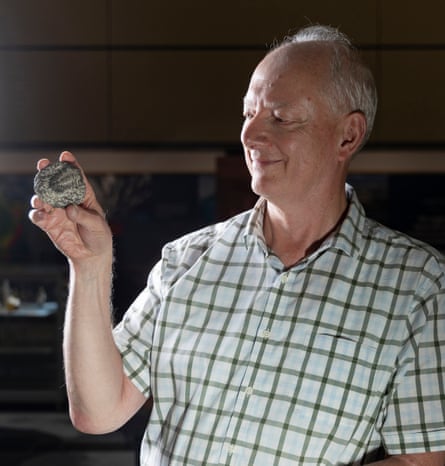
We are speaking on a video call, and Munns holds up to the camera what looks like a lump of grey rock, but is actually a 500m-year-old trilobite that used to roll up into a ball to defend itself. “This one has got about 30 legs, and eyes on the top of its head. It lived in the mud and could see out. This is the thing with invertebrates,” he says. “Their body style is flexible.”
It is this “flexibility of life” that fascinates Munns above all. “How a life form copes with certain pressures, I suppose. I mean, that’s how life works.”
Munns’ own biography contains so many layers and life forms, it sounds a bit like one of his drill cores. After his brief stint as an electronics technician, he shifted into computer engineering in the late 80s. Next came tech support for a multinational, then sales, then teaching adults, until at 40 he started his own business as a computer sales consultant in Canberra.
After 12 years, he sold the company and got the library job – a huge shift in gear and drop in salary – alongside studying for the degree.
Wasn’t he frustrated by the lower level of demand and income?
“I don’t really think that way. It was just my next step,” he says. “You know, a new experience, a new adventure. Off I go. Like I do with all my stuff – just give it a try.” With his wife’s salary, they made ends meet.
Working in the library was a learning experience for him. “It showed me a greater proportion of the public, all the different sorts of people that came through. And it helped me to know that I could help anybody.” He did Giggle and Wiggle rhyme-time sessions with the kids, and helped people who didn’t speak English to access translation services. “I loved it,” he says. “I’m always interested in expanding my horizons, and understanding more about the things that interest me.”
Munns has had to do a fair amount of adapting himself. The biostratigraphy paper he is writing is one he started during his studies, and which he completed amid a slew of “traumatic events”. His parents both died, then Covid happened, after which he was knocked off his bike and broke both arms.
For his next job, he says, he would love to move into evolutionary palaeontology. “I don’t understand this retirement stuff. It doesn’t make any sense to me. Why would I do that? I think it’s more of a cultural thing. You’re expected to retire, so you retire.”
As a palaeontologist, he doesn’t want to be stuck in a cellar, guarding specimens as museum pieces. “I want to be looking at the changes that might happen in all things.”